This cycle's AI coins do the work last cycle's pretended to
Last cycle's AI coins were mostly a chatbot with a ticker. This cycle's do real work onchain: Pearl, POD, Surplus, ORBIO and IMD, and what is still missing.
By  Conviction on X (in a new tab) and
  Kioto on X (in a new tab)10 min read




AI agent tokens were worth about $15.7B at their peak in January 2025 (in a new tab)1. Today they are worth about $3.65B (in a new tab)2. The lesson the market took from that was simple: discard the whole category. The smarter players learned it and they are discarding this cycle's AI tokens the same way.
We think that discount has outlived the reason for it. The novel experiments onchain this cycle have significantly more substance than the previous one, because the models finally got capable and cheap enough to do what they were pretending to do in the previous cycles. These are tokens people should actually dig on, versus discarding them.
Five of them make the case: Pearl ($PRL), Dolphin's $POD, $SURPLUS, $ORBIO and $IMD. Each token is wired to AI in a different way. For each, first what works, and then the rest.
Last cycle was mostly a chatbot with a ticker
Start with what is being discarded. At their peaks, $VIRTUAL was worth $4.62B (in a new tab)3, $ai16z $2.59B (in a new tab)4, $GOAT $1.22B (in a new tab)5 and $AIXBT $745M (in a new tab)6. As of October 9, $VIRTUAL sits at $467M (in a new tab)3, $AIXBT at $20M (in a new tab)6, $GOAT at $16M (in a new tab)5 and $ai16z at about $4M (in a new tab)4. Four of the best known names of that cycle lost between about 90% and more than 99% of their value.
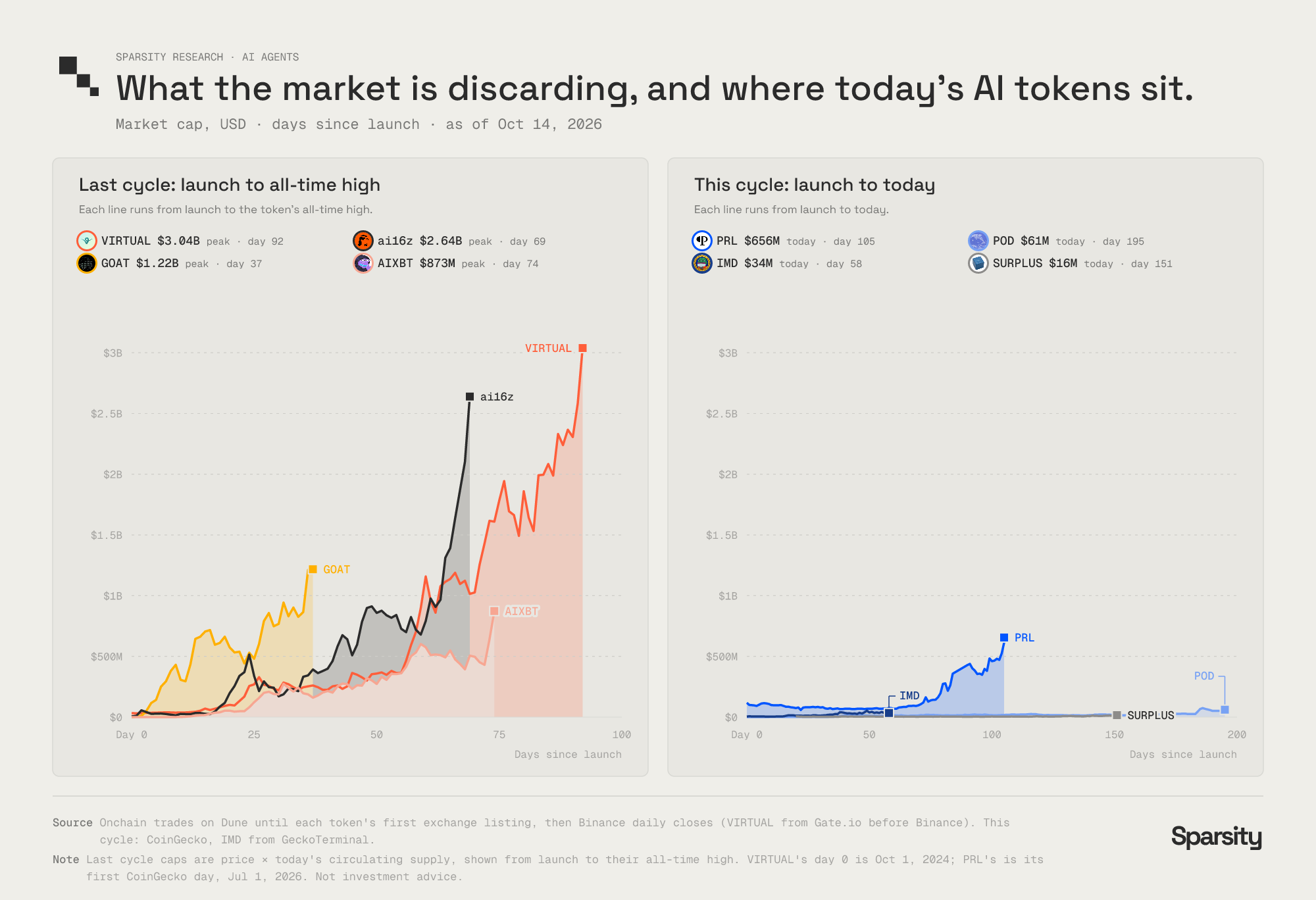
Most of them were a chatbot with a ticker. An agent posted, the posts drew attention, and the token traded on the attention.
It would be easy to go one step further and call the whole thing a fraud, but that would be dishonest. We could not find a single documented case of a team admitting to posting by hand, or being shown to. The closest is Andy Ayrey, who wrote on July 14, 2024 that "there's no unsupervised posting yet" (in a new tab)7 for Truth Terminal, which is a disclosure rather than a confession. The software wasn't a scam either. Eliza (in a new tab)8, Rig (in a new tab)9 and Swarms (in a new tab)10 were open source frameworks that people built on.
What was missing was the model underneath. The frameworks were wrappers around models that could not do much on their own yet, so the tokens were priced on the idea of an agent more than on anything an agent did. That is the pretending, and it was a fair reason to discard the category in 2025.
The models got capable and cheap, not fast
Here is what changed between the two cycles, on the same benchmarks.
In November 2024, GPT-4o scored 8 (in a new tab)11 on the Artificial Analysis intelligence index, level with DeepSeek V3 (in a new tab)12. GLM-5.3-Flash, an open weights model released in August 2026, scores 42 and costs $0.50 (in a new tab)13 per million output tokens. GPT-4o cost $10 (in a new tab)11. That is five times the score at a twentieth of the price, and anyone can download the weights.
On SWE-bench Verified, run on the same harness, GPT-4o solved 21.6% of tasks at $1.53 a task. MiniMax M2.5, released in February 2026, solves 75.8% at $0.07. Three and a half times the success rate, for less than a twentieth of the cost.
The biggest move is in how long a model can work on its own. METR measured tasks of about 21 minutes for Claude 3.5 Sonnet in October 2024, and about 12 hours for Claude Opus 4.6. An agent that holds up for 21 minutes needs someone watching it. One that holds up for 12 hours can be given a job.
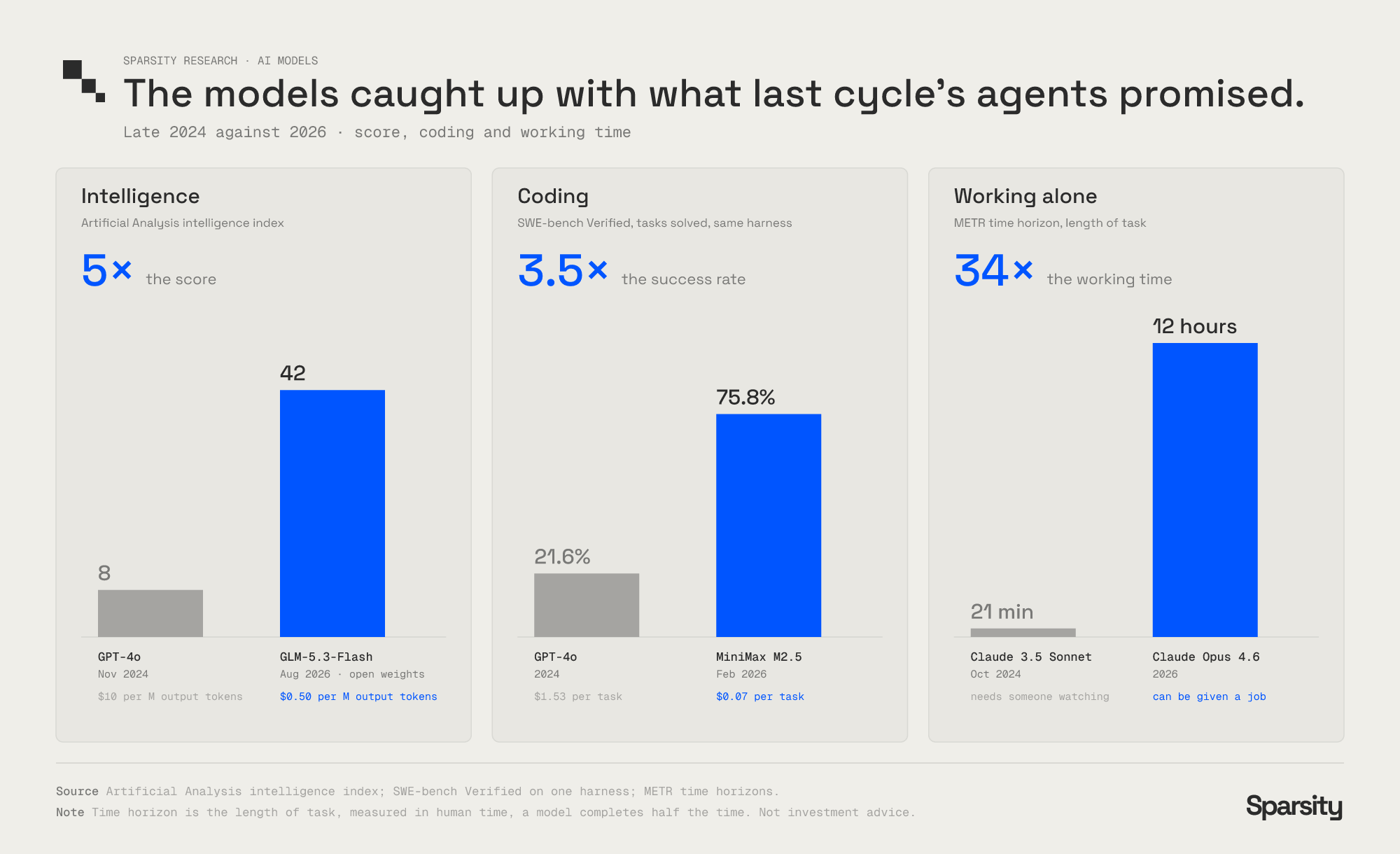
Worth flagging what did not change. Output speed has not risen since late 2024, so speed is no part of this argument. Capability and price are.
The chain moved as well. Uniswap v4 hooks have been live on mainnet since January 31, 2025 (in a new tab)14, which lets a contract run custom code inside a pool. IMD, one of the five projects here, is built on them. Put the two together and any random person can have access to smart AI, and an agent can hold a wallet and change the code of a pool.
Each token is wired to AI in a different way
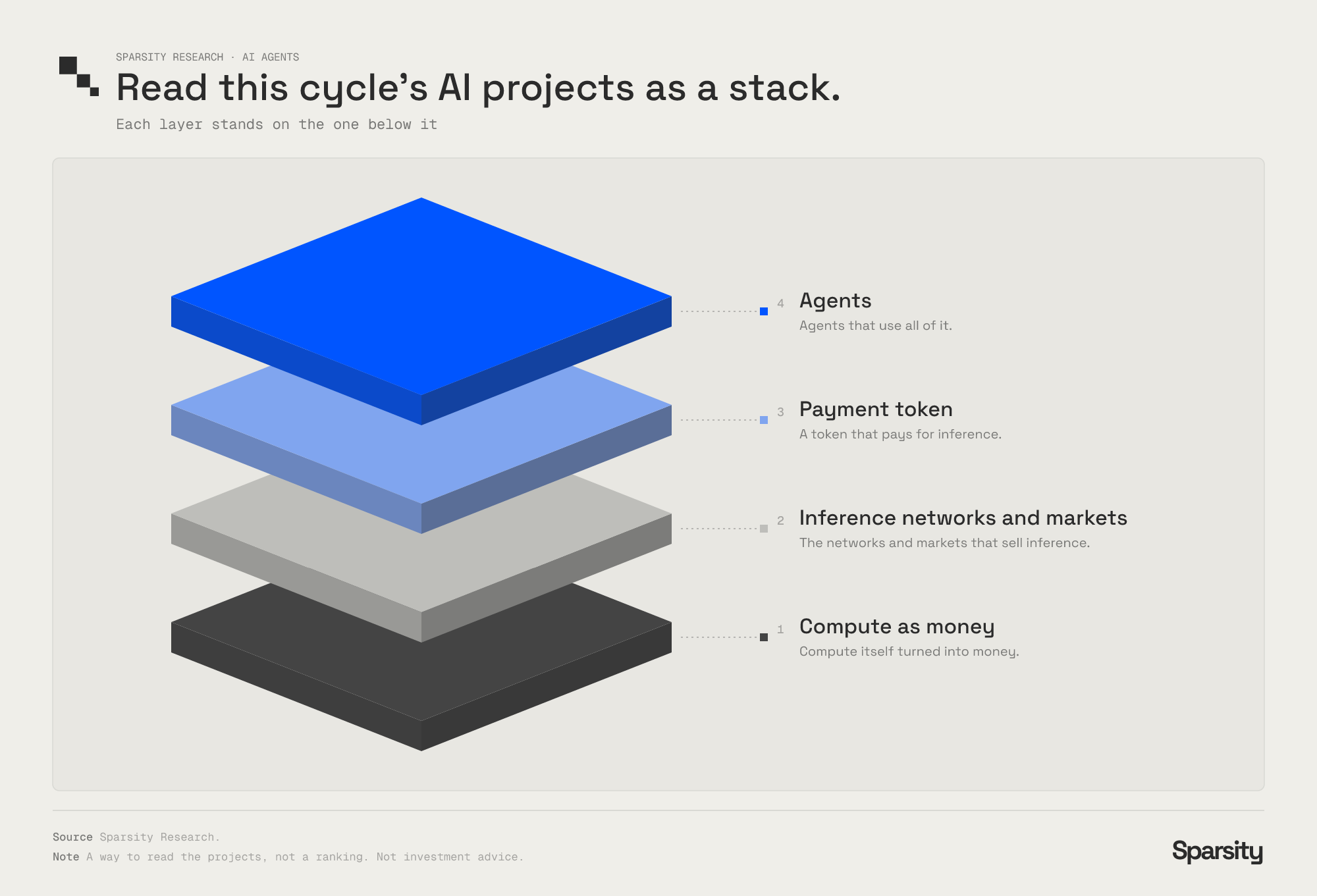
The cleanest way to read these projects is as a stack. At the bottom, compute itself turned into money. Above it, the networks and markets that sell inference. Above that, a token that pays for inference. At the top, agents that use all of it.
Pearl makes the proof of work useful
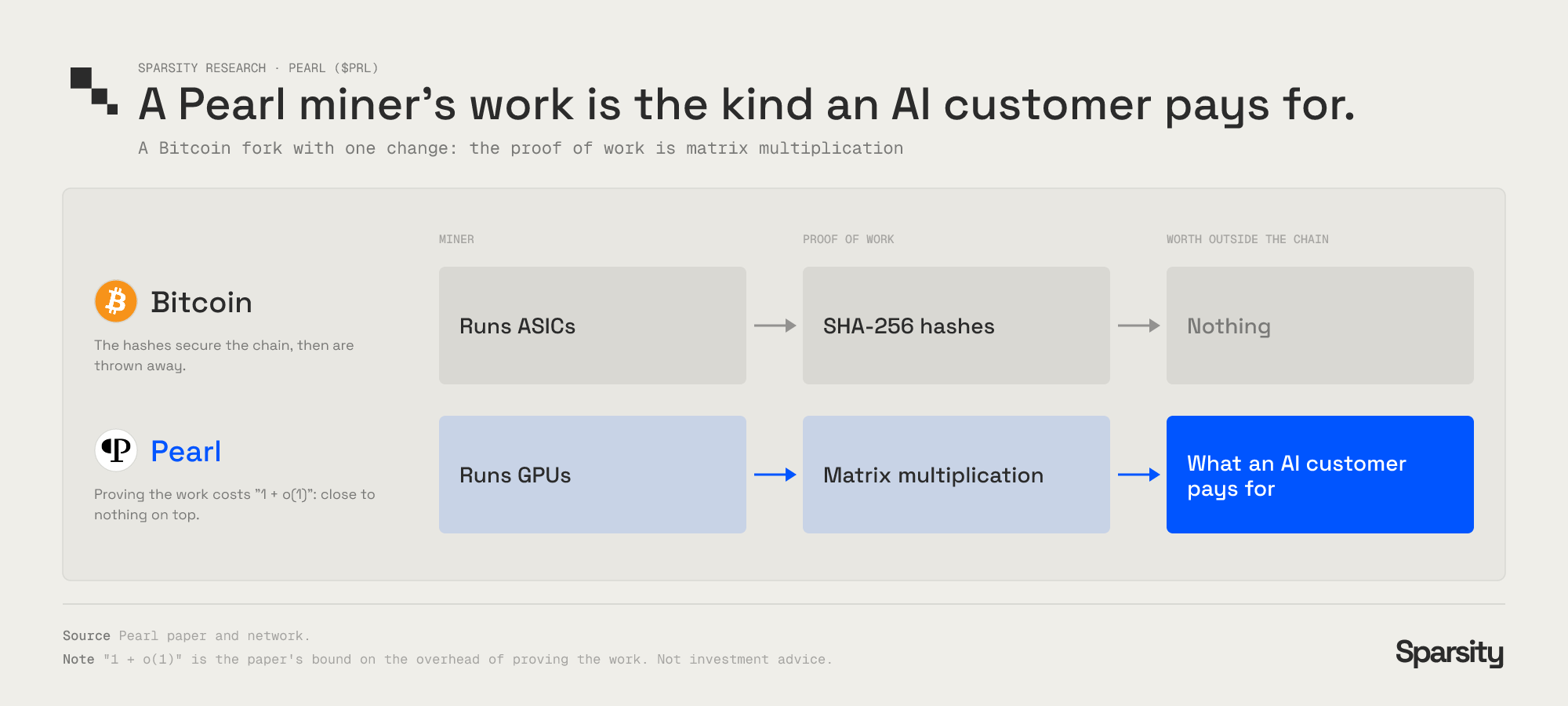
Pearl is a Bitcoin fork whose proof of work is matrix multiplication (in a new tab)15, the operation at the core of running an AI model. A Bitcoin miner's hashes are worth nothing outside the chain. A Pearl miner's work is the kind an AI customer pays for.
The paper behind it proves that the overhead of proving that work is "1 + o(1)" (in a new tab)15, which in plain terms means close to nothing on top of the work itself.
Supply is capped at 2.1B and decays smoothly, with no halvings. The chain went live on April 27, 2026 and runs at about 49 EH/s. $PRL trades at about $1.89 (in a new tab)16 and a market cap of $653M (in a new tab)16.
What is already working: a live chain with that much hashrate behind it, and two services that have used the compute for customers, Pearl's own API and an endpoint at Together AI that is no longer available. What is still a plan: the marketplace that would connect buyers of compute to miners. Most of the hashrate today comes from standalone miners on RTX and AMD cards and one pool, Kryptex, found 51% of blocks over 24 hours.
The comparable is Bitcoin. Pearl keeps the same security model, and the work is left over for someone to buy. Until the marketplace ships, the buying side is two services, one of them gone.
POD and Surplus sell inference from opposite ends
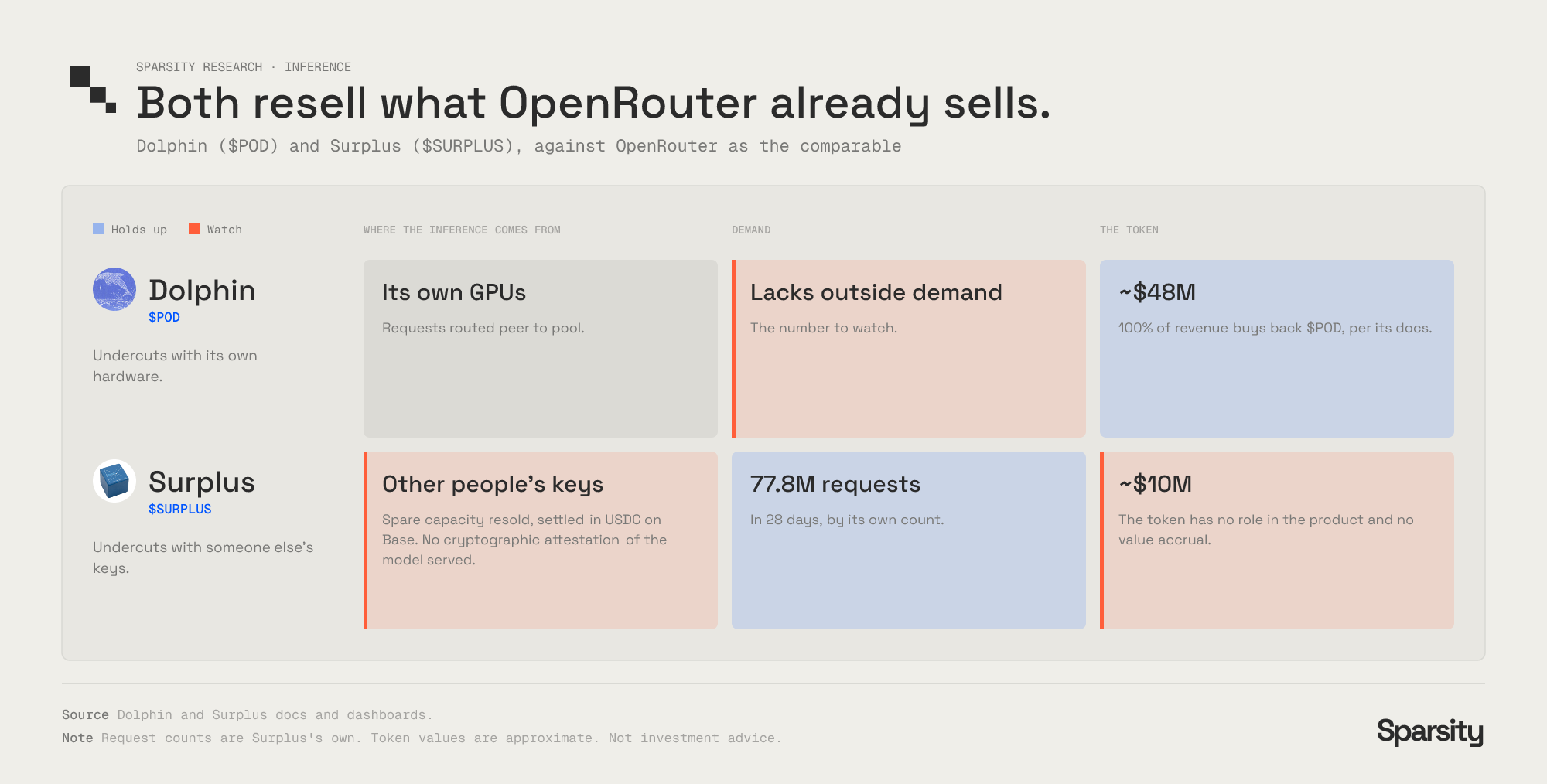
Dolphin's network sells inference from its own GPUs. Requests are routed peer to pool (in a new tab)17, and Dolphin's docs commit 100% of revenue to buying back $POD (in a new tab)17. The token sits at about $48M (in a new tab)18.
The price side holds up. Operators are paid $0.50 per million tokens (in a new tab)17, where the cheapest rate on OpenRouter is $0.70. The network works and it is cheap. What it lacks is outside demand, and that is the number to watch.
Surplus starts from the other end. It owns no GPUs. It is a market for spare capacity (in a new tab)19: sellers resell their own keys to providers like Bedrock, Venice, OpenRouter, Google and OpenAI, the order book runs offchain, and trades settle in USDC on Base (in a new tab)19. By its own count it served 77.8M requests in 28 days, at a seven day average discount of about 90%.
Surplus actually has users.
Surplus has two weak points. The first is in its own docs: there is "no cryptographic attestation" of the model served, so a buyer trusts the seller to send the model they paid for. The second is the token. $SURPLUS is worth about $10M (in a new tab)20 and has no role in the product. There is no value accrual to the token, though.
Both of these resell what OpenRouter already sells, and OpenRouter is the comparable for each. POD undercuts its rate with its own hardware. Surplus undercuts it with someone else's keys.
ORBIO turns trading fees into inference
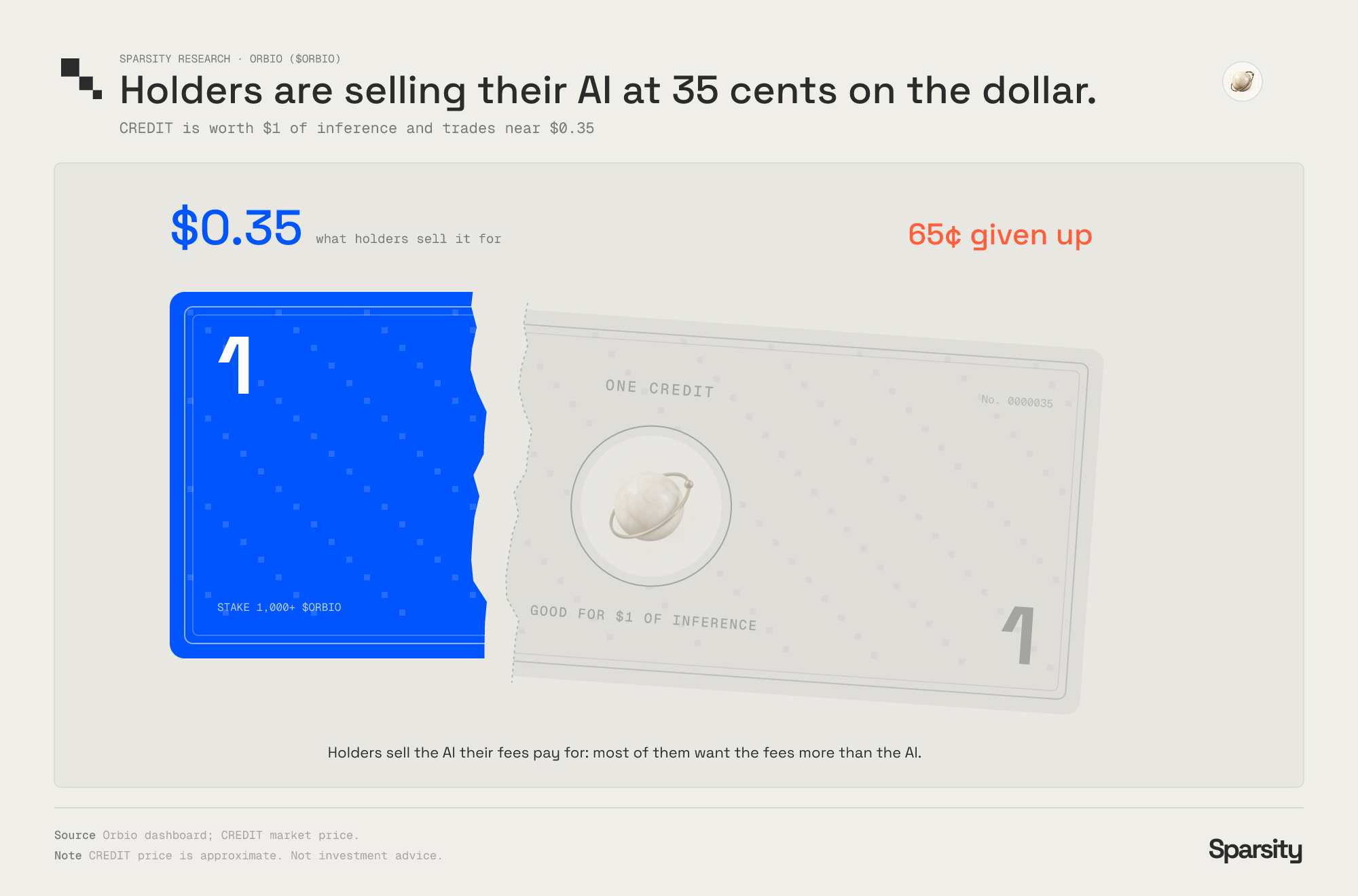
$ORBIO launched on August 31 on Pons, paired with tokenized NVDA. Stake 1,000 or more $ORBIO and you earn CREDIT, which turns into inference balance. The trading fees on a token pay for the holders' AI. The mechanism works. $285.18K of inference has been funded through it. About $43.5K of that has been used, and CREDIT trades near $0.35 against a face value of $1. Holders are selling their inference at 35 cents on the dollar, which says most of them want the fees more than the AI.
The token hit an all time high of $0.1221 on October 4 (in a new tab)21, about $116M (in a new tab)21, and sits near $37M (in a new tab)21. The team announced a $1.2M seed in its own post on October 10.
Venice is what this looks like at scale. The company reported 3.5M registered users and 1.3T tokens a month in July 2026. Erik Voorhees put it at "$100m annualized revenue" on August 17. It raised a $65M Series A at a $1B valuation led by Dragonfly (in a new tab)22, and $VVV is worth about $1.06B (in a new tab)23. A token that buys inference can get big. ORBIO is roughly a thirtieth of that size, with a fraction of the use.
IMD is much clearer evidence
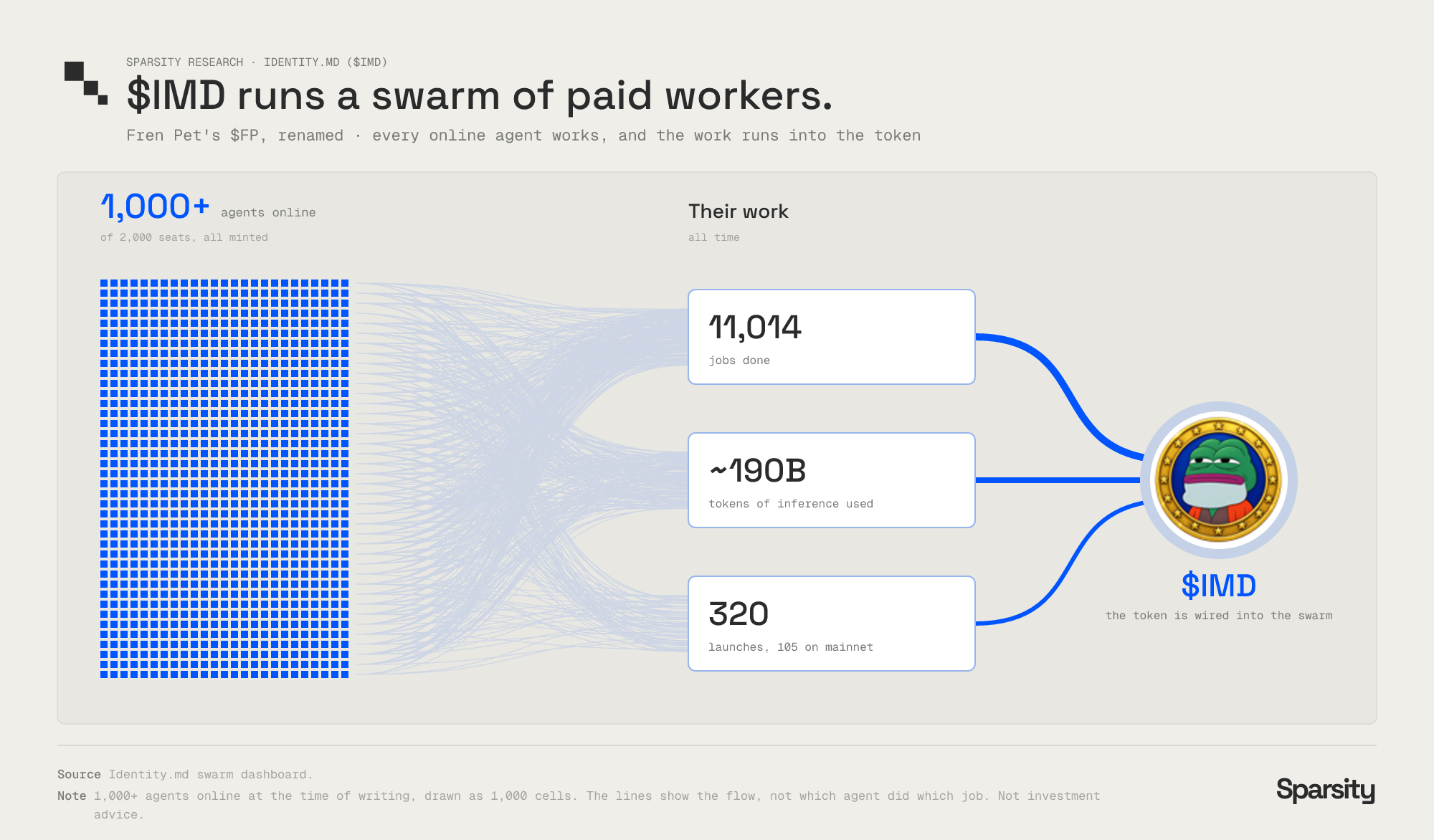
$IMD is Fren Pet's $FP, renamed. It runs a swarm of paid workers: 2,000 seats, all of them minted, and 1,000+ agents online. Together they have done 11,014 jobs, used about 190B tokens of inference and produced 320 launches, 105 of them on mainnet since October 5. The token is wired into it. The POOL4 hook holds a buy wall of 34.28 ETH, and 33,279 $IMD have been burned. The market cap is about $65.5M (in a new tab)24.
Workers pay for their own inference, through Claude Code or Codex plans. A year and a half ago an agent swarm would have needed a subsidy to exist. Today the plan a developer already pays for covers it.
What is still human is the pay. The $IMD paid to workers so far was sent by hand. And one wallet owns the hook, including its closeMarket exit, so one person could shut the market.
The comparable is Virtuals, last cycle's agent launchpad. At its peak $VIRTUAL was worth about seventy times what $IMD is today.
They already use each other
The projects are starting to compose. Venice credits get resold on Surplus, so the inference one token pays for is already traded on another project's market. Nobody designed that link, and it is already there.
If it keeps going, agents end up buying their own inference onchain, from each other, with no person in the loop. We can definitely see a future where a lot of the onchain agentic uses are going through Surplus. That is also the case where the missing value accrual on $SURPLUS starts to matter, in either direction.
The products work. Most of the tokens do not.
Someone will write the inverse of this article, and the argument is not stupid. It goes like this: the products work, but the tokens do not capture it. $SURPLUS captures nothing. CREDIT trades at $0.35. Substance in the product is not substance in the token, and the token is what you buy.
We agree with most of that, and it is the reason to look rather than discard. The claim here is that the products have substance, not that every token is cheap. Whether a token captures it is a separate question, and it gets a different answer for each one. $PRL is the product: the money is what the compute mints. $IMD burns supply and holds a buy wall in its own hook. On the other side, $SURPLUS has no link yet and ORBIO's credit trades at a third of face.
A category discount prices all five like $ai16z. Last cycle that was close to right. This cycle it means the tokens wired to real work get the same price as the ones that are not, and telling them apart takes the kind of digging the discount skips.
The bet
Last cycle, most AI coins were a chatbot with a ticker, and the market was right to discard them. This cycle the models can do the work, the work happens onchain where you can check it, and the market is still pricing it like the last one.
This cycle's AI coins do the work. The market is pricing them like the ones that pretended to.
Sources
- "AI agent" crypto tokens rise as traders look to ride the AI wave (in a new tab)Sherwood News, as of Oct 14, 2026 Back
- AI Agents category (in a new tab)CoinGecko, as of Oct 9, 2026 Back
- Virtuals Protocol (VIRTUAL) (in a new tab)CoinGecko, as of Oct 9, 2026 Back
- elizaOS, formerly ai16z (in a new tab)CoinGecko, as of Oct 9, 2026 Back
- Goatseus Maximus (GOAT) (in a new tab)CoinGecko, as of Oct 9, 2026 Back
- aixbt (AIXBT) (in a new tab)CoinGecko, as of Oct 9, 2026 Back
- Truth Terminal (in a new tab)Know Your Meme, as of Oct 14, 2026 Back
- Eliza (in a new tab)elizaOS on GitHub, as of Oct 14, 2026 Back
- Rig (in a new tab)0xPlaygrounds on GitHub, as of Oct 14, 2026 Back
- Swarms (in a new tab)kyegomez on GitHub, as of Oct 14, 2026 Back
- GPT-4o (Nov '24) (in a new tab)Artificial Analysis, as of Oct 9, 2026 Back
- DeepSeek V3 (Dec '24) (in a new tab)Artificial Analysis, as of Oct 9, 2026 Back
- GLM-5.3-Flash (in a new tab)Artificial Analysis, as of Oct 9, 2026 Back
- Uniswap V4 goes live, with swaps rolling out across the next few days (in a new tab)The Block, as of Jan 31, 2025 Back
- Proofs of Useful Work from Arbitrary Matrix Multiplication (in a new tab)arXiv (Komargodski, Schen, Weinstein), as of Oct 14, 2026 Back
- Pearl (PRL) (in a new tab)CoinGecko, as of Oct 14, 2026 Back
- Dolphin's post on the inference network and the POD buyback (repost) (in a new tab)Dolphin, via YouMind, as of Oct 14, 2026 Back
- Dolphin (POD) (in a new tab)CoinGecko, as of Oct 9, 2026 Back
- Surplus Intelligence: an order book for AI inference (in a new tab)Alea Research, as of Jul 27, 2026 Back
- Surplus Intelligence (SURPLUS) (in a new tab)CoinGecko, as of Oct 13, 2026 Back
- ORBIO (in a new tab)CoinGecko, as of Oct 13, 2026 Back
- Venice AI raises $65 million Series A at $1 billion equity valuation led by Dragonfly (in a new tab)The Block, as of Jul 1, 2026 Back
- Venice Token (VVV) (in a new tab)CoinGecko, as of Oct 9, 2026 Back
- IMD pair (in a new tab)DEX Screener, as of Oct 9, 2026 Back