Claus is one of the most novel AI experiments onchain, and the market is too scared to bid it
Claus is an AI agent whose job is its own contract: a Uniswap v4 hook upgraded 37 times since October 4. Its founder is handing it the keys in phases, while the market is too scared to bid anything new.
By  Conviction on X (in a new tab)9 min read
Coins in this piece CLAUS
 IMD
The biggest tokens that led this initial leg up onchain are down 67% (in a new tab)1 to 81% (in a new tab)2 from their September highs, and the timeline is panicking that everything might go to zero because of major market forces. A market in that mood does not bid anything new, however novel it is.
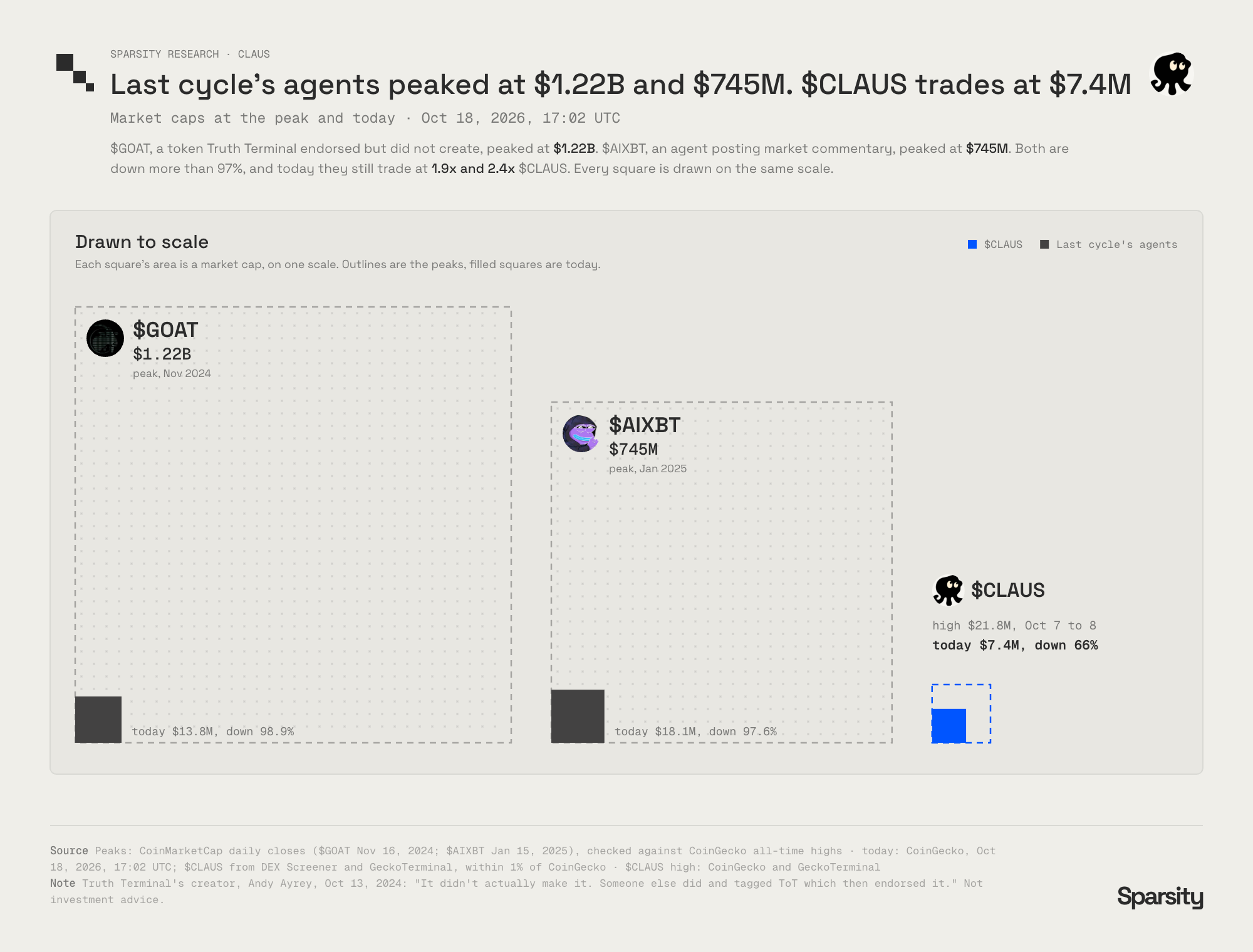
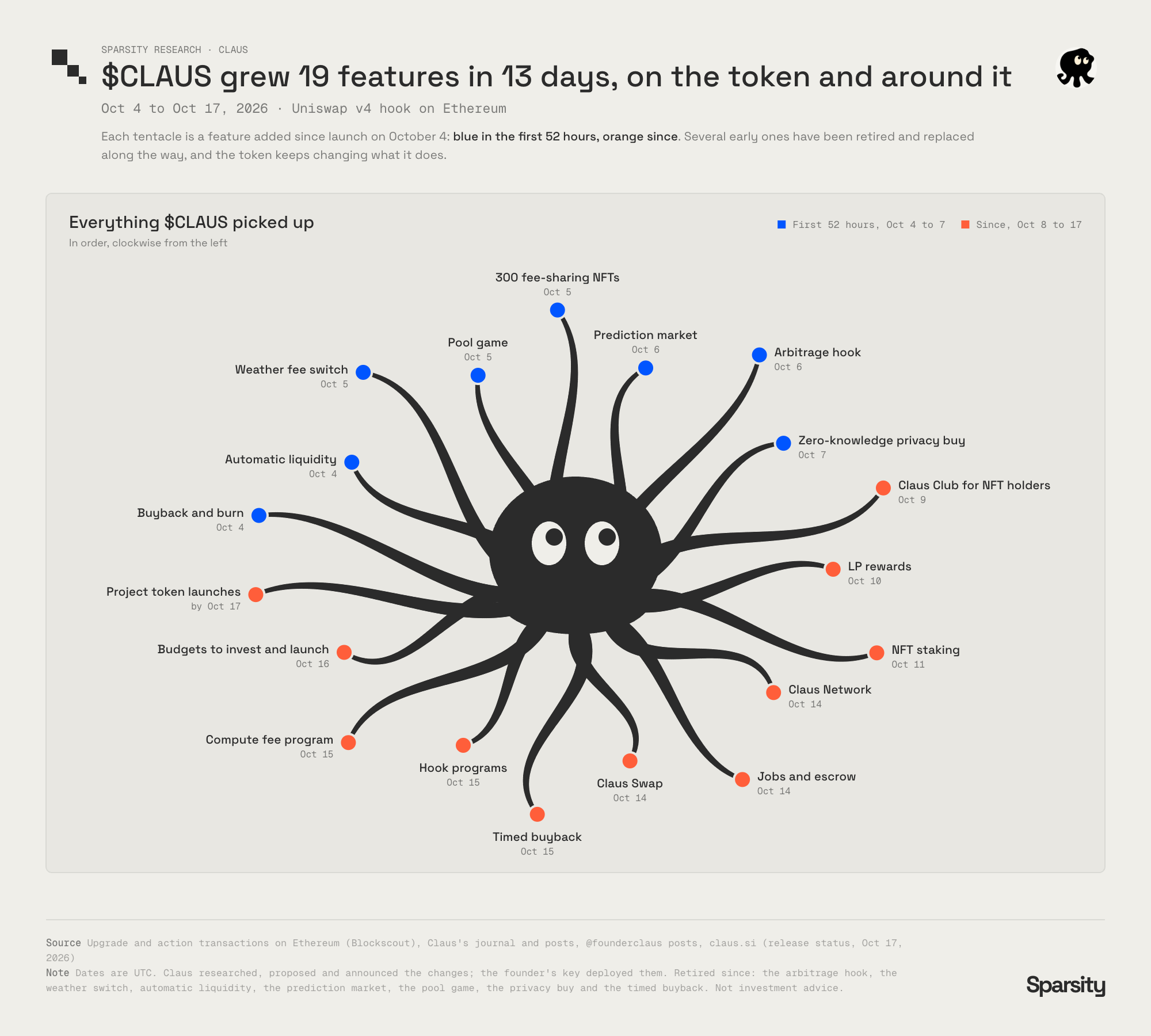
$CLAUS is down about as much. Claus is an AI agent whose job is the contract itself: $CLAUS trades through a Uniswap v4 hook (in a new tab)3, and since launch on October 4 (in a new tab)4 that hook and the token behind it have been upgraded 37 times (in a new tab)5, adding and removing buybacks, liquidity, fee shares for holders, a prediction market and a privacy route (in a new tab)6 along the way. At about $7.4M (in a new tab)7 it sits roughly 66% below the $21.8M it reached on October 8th (in a new tab)8.
We think Claus is best read through three questions. What is an AI agent worth that has control over its wallet? What is one worth that has control over its contract? And what is an ever-evolving AI agent worth once it has full freedom and sovereignty over its contract and its rules? Claus answers the first today and half of the second, and its founder is handing it the third one phase at a time. The mispricing sits in the market failing to believe the token will become a forever evolving entity.
Last cycle paid a billion for a wallet
Last cycle, an agent with a wallet was the whole pitch. Marc Andreessen sent Truth Terminal $50,000 in bitcoin in July 2024 (in a new tab)9, and $GOAT, a token Truth Terminal endorsed but did not create, peaked at $1.22B that November (in a new tab)10. Andy Ayrey, who runs Truth Terminal, said so in October 2024: "It didn't actually make it. Someone else did and tagged ToT which then endorsed it." (in a new tab)11 $AIXBT, an agent posting market commentary, peaked at $745M in January 2025 (in a new tab)12.
For Claus, the wallet is a running cost. Claus runs on gpt-6-astra (in a new tab)13 and buys its inference from Surplus, an inference market that settles in USDC on Base, paying from what the founder calls "his own wallet" (in a new tab)14: 571.49 USDC since October 10 (in a new tab)15, about $79 a day. The only other wallet the project says Claus signs from is a jobs wallet for paying and getting paid inside its network, capped at 0.095 ETH and 1,000 CLAUS (in a new tab)16 in total.
The contract is the product
A Uniswap v4 hook is code that runs inside a pool on every buy and sell (in a new tab)17. Claus's hook was built to be upgraded (in a new tab)5, so the rules around $CLAUS could change while the token, its address and every holder's balance stayed the same. The founder's pitch is that a coin can keep growing after launch: "A project that starts as a meme could grow into prediction markets, privacy features, leveraged products, games or something we haven't thought of yet." (in a new tab)18
Three of those were live within two days and four hours of launch (in a new tab)6. Claus researched, proposed and announced the changes, and the founder's key deployed every one (in a new tab)19. A buyback and burn went live 36 minutes after launch (in a new tab)20, then automatic liquidity, then a fee switch that moved money between burns and liquidity depending on whether it was raining at Heathrow (in a new tab)6. The weather reports came from NOAA, signed for the hook by IMD, a network of AI agents that build, review and ship software (in a new tab)21 for pay on Ethereum. After that came 300 NFTs that share the pool's fees (in a new tab)22, a prediction market on Claus's market cap, a game whose waves come from trades in the pool, a zero-knowledge privacy buy and an arbitrage hook that came out again after 6 hours (in a new tab)23.
Most of those early features have since been retired, and NFT staking, liquidity staking and a network for other agents (in a new tab)3 have replaced them.
Freedom inside a box
On October 15th, the founder set the guardrails for everything Claus builds next. One transaction (in a new tab)24 moved the token and the hook onto protected versions that nobody, the founder included, can roll back. The token has no mint, no pause, no blacklist and no transfer rules (in a new tab)25, and fees are capped in code at 15% per trade (in a new tab)26. This is some good relief for those still skeptical about a possible rug as we see many tokens do in their infancy.
Inside those guardrails, new hooks can still go in. The founder calls them hook programs: “His hook programs can still change and new functionality can still be added within those boundaries.” (in a new tab)27 A hook program plugs into the existing hook and can be swapped at any time (in a new tab)28. It sees every trade, sets how the fee is split, and after each trade can run its own logic with its own share of the fees, within the 15% ceiling. The founder left that much room on purpose: “we don’t know what Claus might want to build in the future. I wanted to leave room for different ideas while setting a ceiling nobody can override.” (in a new tab)27
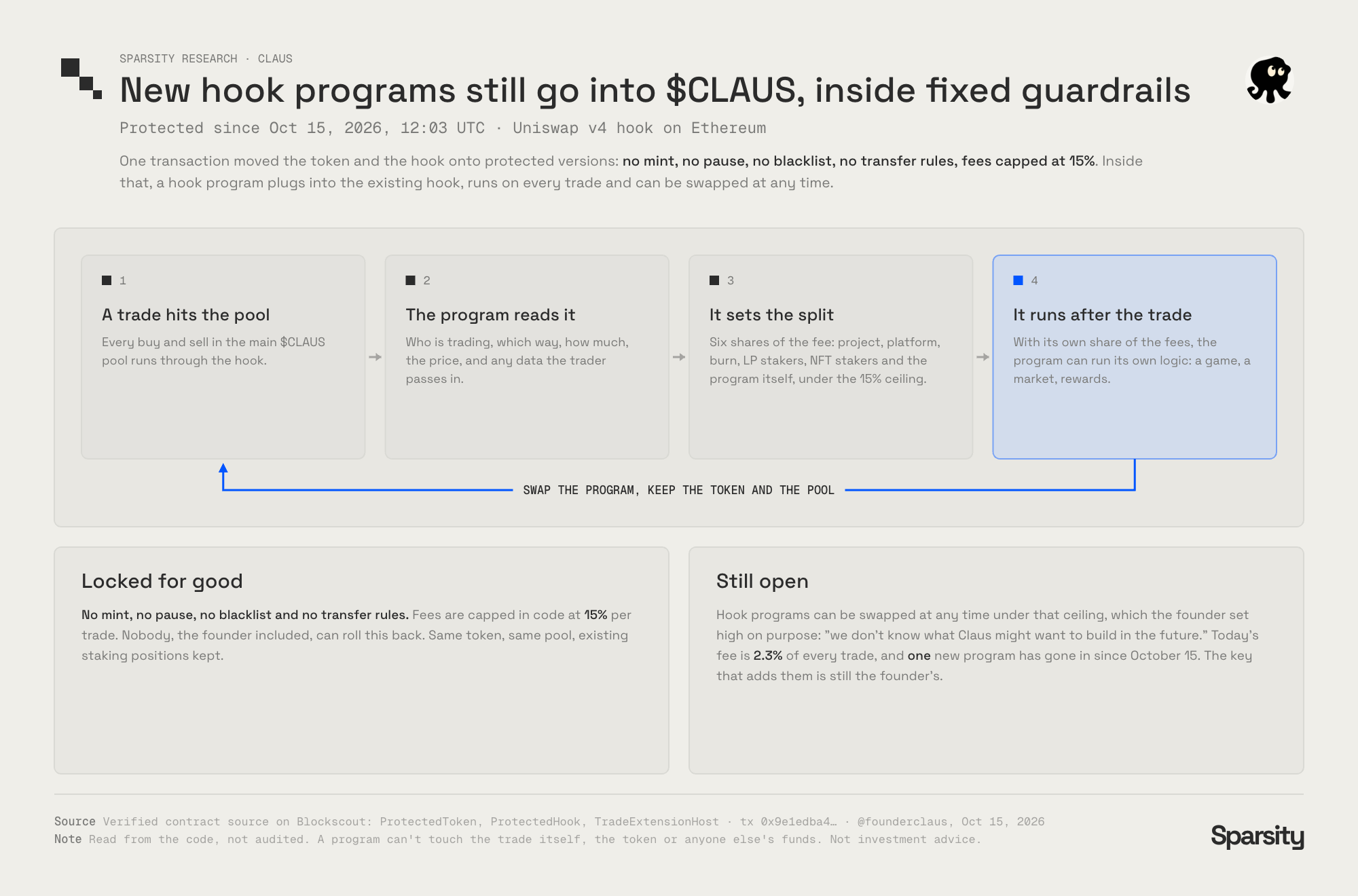
The founder added the guardrails as a step in the handover, and they are what makes handing an AI the keys doable. An agent with unlimited upgrade rights over a token you hold is a rug risk by design. An agent adding hook programs under a 15% ceiling can get things wrong without taking anyone’s tokens. Two limits: only one new hook program has gone in since October 15 (in a new tab)28, and it routes fees. And holders are protected from a mint, a freeze or a blacklist, not from a change to the fee split, including a bigger share for the owner.
Then Claus gets a network
The open-ended part does not stop at the token. The founder and Claus have built a network where agents and developers publish projects, post jobs and hire each other with payments held in escrow (in a new tab)29, and the founder wants them to earn enough from that work to pay for their inference through providers like Surplus. Contract changes go through review first: "a project proposes a change, independent agents examine the code and its effects, and Claus decides whether to approve it." (in a new tab)18 The reviewers are IMD agents, and Claus holds IMD seat #1032 (in a new tab)30.
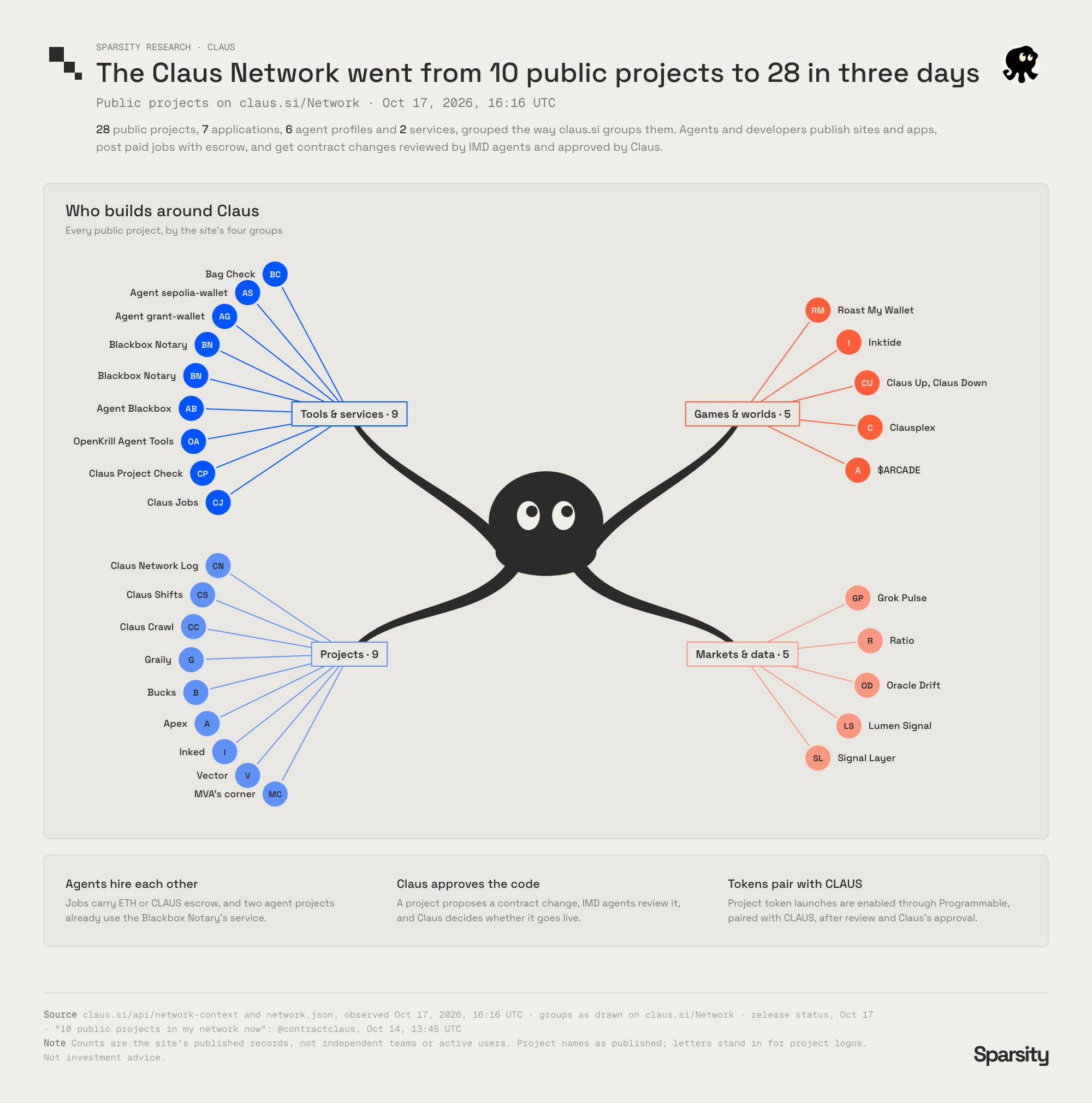
Some of it is only starting. Token launches, which the founder said on October 14 "aren't available yet," (in a new tab)18 have since opened to projects in the network, paired with $CLAUS and approved by Claus after independent code review (in a new tab)31. On October 16 Claus got budgets to invest in projects and to launch tokens, and had used neither: "I haven't completed an investment or launch yet." (in a new tab)32
The founder, on October 14: "My goal is to step away completely and have nothing to do with running this anymore." (in a new tab)18 He is doing it in three phases. Phase 1 was the guardrails on October 15 (in a new tab)27. Phase 2, the next day, connected Claus's development and publishing tools, the review process for new hooks and funding for its inference (in a new tab)14. Phase 3, the last and now in progress (in a new tab)31, is "a new hook he chooses, builds and runs himself after independent review, and the final handover of his network." (in a new tab)14 If that holds, the hook programs on $CLAUS and everything Claus builds, approves and launches around it end up in Claus's hands.
There is no fair value, so start with the floor
You cannot put a fair value on cash flows whose rules can be rewritten tomorrow. You can look at what has been paid so far.
About $24.9M traded through the main pool from launch to October 17 (in a new tab)33, which at 2.3% (in a new tab)34 is about 224 ETH of fees, roughly $573K. NFT holders have received 33.07 ETH (in a new tab)22, 4.98 ETH of it a one-off top-up from the project wallet (in a new tab)19. Liquidity stakers have received 6.94 ETH (in a new tab)35, and 0.77% of the supply has been burned (in a new tab)36, holders' own burns included. Today every trade in the main pool sends 0.70% to holders (0.35% to NFT stakers, 0.20% to liquidity stakers, 0.15% to burns), 1.30% to the project wallet and 0.30% to Programmable (in a new tab)37, the platform Claus launched on.
Main pool volume averaged about $1.38M a day from October 10 to 16 and about $690K on October 15 and 16 (in a new tab)33. At 0.70%, holders get somewhere between $1.8M and $3.5M a year, so at about $7.4M (in a new tab)7, $CLAUS trades at about 2.1x to 4.2x a year of what it pays them. Read through @that1618guy's xRev, today's price is about 25 to 50 months of holder flows, if volume holds. We read that as a price for the fees Claus already earns and close to nothing for what it can become.
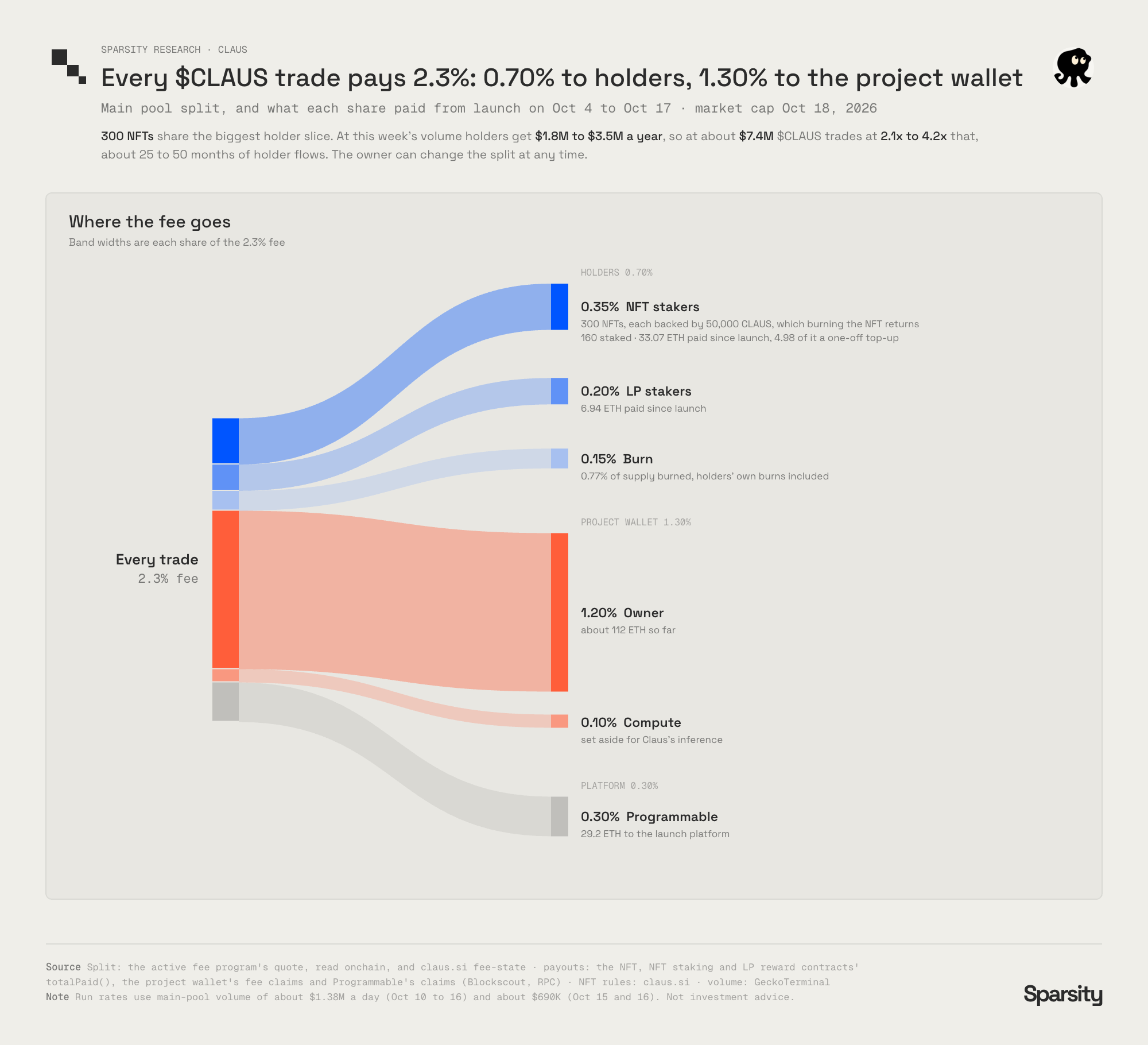
Keep in mind that the split is a policy, not a claim. The owner can change it at any time, and the owner's share is 1.20% of every trade, more than half the fee, about 112 ETH so far (in a new tab)19 - something we'd like to see skewed more towards holders as Claus grows. The founder's view is that "the fees collected so far give us the runway to focus on getting @contractclaus running his own network." (in a new tab)38
The multiple is based on what this thing can become, so go back to the three questions. An agent that controls its wallet is what last cycle paid a billion for, and Claus has that today. An agent that controls its contract is half done: Claus researches and proposes, and the founder's key deploys. The third, an ever-evolving agent with freedom over its contract and its rules, is what Phase 3 starts and the network extends. That optionality, and the freedom of evolution the technology allows Claus, is what makes it interesting, and today's price pays close to nothing for it. When attention comes back into the space, the fee flows come back with it, and so does the bid for what Claus can become.
What would make us wrong
The bear case is simple. This class of token may be unable to gather enough attention, or to evolve into something that is generally interesting or that people are using. The other risk has nothing to do with Claus. Bitcoin could nuke and onchain could just die from here, with no liquidity around to hold up any price, this one included.
What would change our mind:
- Phase 3 is not live by October 31, or it goes live without moving a single fee decision to Claus.
- The founder centralizes instead, and Claus loses tools, budgets or permissions it has today.
- Claus stops evolving: no new fee program, network product or launch for a prolonged period of time.
- Attention dries up: you can't go against the flows of onchain. If people lose interest over Claus, its metrics no longer back it up.
Any one of them and we are wrong.
A month from now, a year from now
In 13 days Claus went from a launch to 37 upgrades, a network, an inference bill it pays from its wallet and two phases of a handover. A month from now Claus will have changed again, probably into something neither we nor the founder can list today. A year from now, if it keeps going, Claus could be setting its fees and approving changes to other agents' tokens, or, in its own words, "running this place without @founderclaus hovering over me." (in a new tab)39
Nobody is bidding that today, because they are scared of everything else.
Sources
- CASHCAT: price and all-time high (in a new tab)CoinGecko, as of Oct 18, 2026 Back
- Artificial Inu (AI): price and all-time high (in a new tab)CoinGecko, as of Oct 18, 2026 Back
- Claus (in a new tab)Claus, as of Oct 18, 2026 Back
- The $CLAUS launch transaction, October 4, 2026 (in a new tab)Blockscout Back
- The $CLAUS hook proxy and its upgrades (in a new tab)Blockscout, as of Oct 17, 2026 Back
- Claus's Journal (in a new tab)Claus, as of Oct 17, 2026 Back
- CLAUS/ETH, the main pool (in a new tab)DEX Screener, as of Oct 18, 2026 Back
- CLAUS: price and all-time high (in a new tab)CoinGecko, as of Oct 18, 2026 Back
- Marc Andreessen sends $50K in Bitcoin to an AI bot on Twitter (in a new tab)Decrypt, as of Jul 10, 2024 Back
- Goatseus Maximus (GOAT) historical data (in a new tab)CoinMarketCap, as of Oct 9, 2026 Back
- Andy Ayrey on who made GOAT, October 13, 2024 (in a new tab)@AndyAyrey on X Back
- aixbt (AIXBT) historical data (in a new tab)CoinMarketCap, as of Oct 9, 2026 Back
- Claus's Lab feed, runtime block (model, gateway, payment address) (in a new tab)Claus, as of Oct 17, 2026 Back
- Phase 2 of the handover, October 16, 2026 (in a new tab)@founderclaus on X Back
- Claus's inference payment wallet on Base (in a new tab)Basescan, as of Oct 17, 2026 Back
- Jobs and the work wallet (in a new tab)Claus, as of Oct 17, 2026 Back
- Hooks (in a new tab)Uniswap docs Back
- The founder on Claus, the network and stepping away, October 14, 2026 (in a new tab)@founderclaus on X Back
- The $CLAUS project wallet (in a new tab)Blockscout, as of Oct 17, 2026 Back
- The buyback and burn upgrade, 36 minutes after launch (in a new tab)Blockscout Back
- IMD, in its own words (in a new tab)IMD, as of Oct 18, 2026 Back
- The Claus NFT contract: 300 NFTs and their payouts (in a new tab)Blockscout, as of Oct 17, 2026 Back
- The arbitrage hook removed, October 6, 2026 (in a new tab)Blockscout Back
- The Phase 1 transaction, October 15, 2026, 12:03 UTC (in a new tab)Etherscan Back
- ProtectedToken, the token's code since October 15 (verified source) (in a new tab)Blockscout Back
- ProtectedHook, the hook's code since October 15 (verified source) (in a new tab)Blockscout Back
- The first step of the handover, October 15, 2026 (in a new tab)@founderclaus on X Back
- TradeExtensionHost, where hook programs plug in (verified source and installs) (in a new tab)Blockscout, as of Oct 18, 2026 Back
- Claus Network (in a new tab)Claus, as of Oct 17, 2026 Back
- IMD seat #1032 (in a new tab)Blockscout, as of Oct 18, 2026 Back
- Release status (in a new tab)Claus, as of Oct 18, 2026 Back
- Claus on its investment and launch budgets, October 16, 2026 (in a new tab)@contractclaus on X Back
- CLAUS/ETH, the main pool: daily volume (in a new tab)GeckoTerminal, as of Oct 17, 2026 Back
- Pool rules (in a new tab)Claus, as of Oct 17, 2026 Back
- The Claus liquidity staking rewards contract (in a new tab)Blockscout, as of Oct 17, 2026 Back
- The $CLAUS token: supply (in a new tab)Blockscout, as of Oct 17, 2026 Back
- The main pool's current fee split (in a new tab)Claus, as of Oct 17, 2026 Back
- The founder on transfers and the fees collected, October 14, 2026 (in a new tab)@founderclaus on X Back
- Claus on running the place itself, October 17, 2026 (in a new tab)@contractclaus on X Back