How Pumpfun is killing the trenches
pump.fun earns on coins that die in their first hour, and it pays for the behavior that broke holder culture. What that looks like, and what would change it.
By  Kioto on X (in a new tab)11 min read
Coins in this piece PUMP
"The onchain conditions are unfavorable." "All KOLs are extracting." "We keep idolizing bundlers."
These are prominent problems, but it doesn't make sense to search for the issue at the bottom of the hierarchy. Holder culture in the trenches is broken. Nobody holds anymore: people vamp runners, deploy dozens of coins, bundle launches and farm callouts, because that's what pays. The problems sit higher up, with the platform that owns the trenches. The biggest memecoin launchpad pays for the exact behavior everyone complains about, and it has turned memes into a market with infinite supply and disappearing demand.
Everyone wants KOLs to be accountable for their calls right now, and that's good. But holding callers to account isn't enough if the platform paying them never answers for anything.
pump.fun earns on the coins that die
Over the last 30 days, pump.fun had 92% of all memecoin launchpad launches and 84% of launchpad volume (in a new tab)1 across every chain. It decides what pays in the trenches.
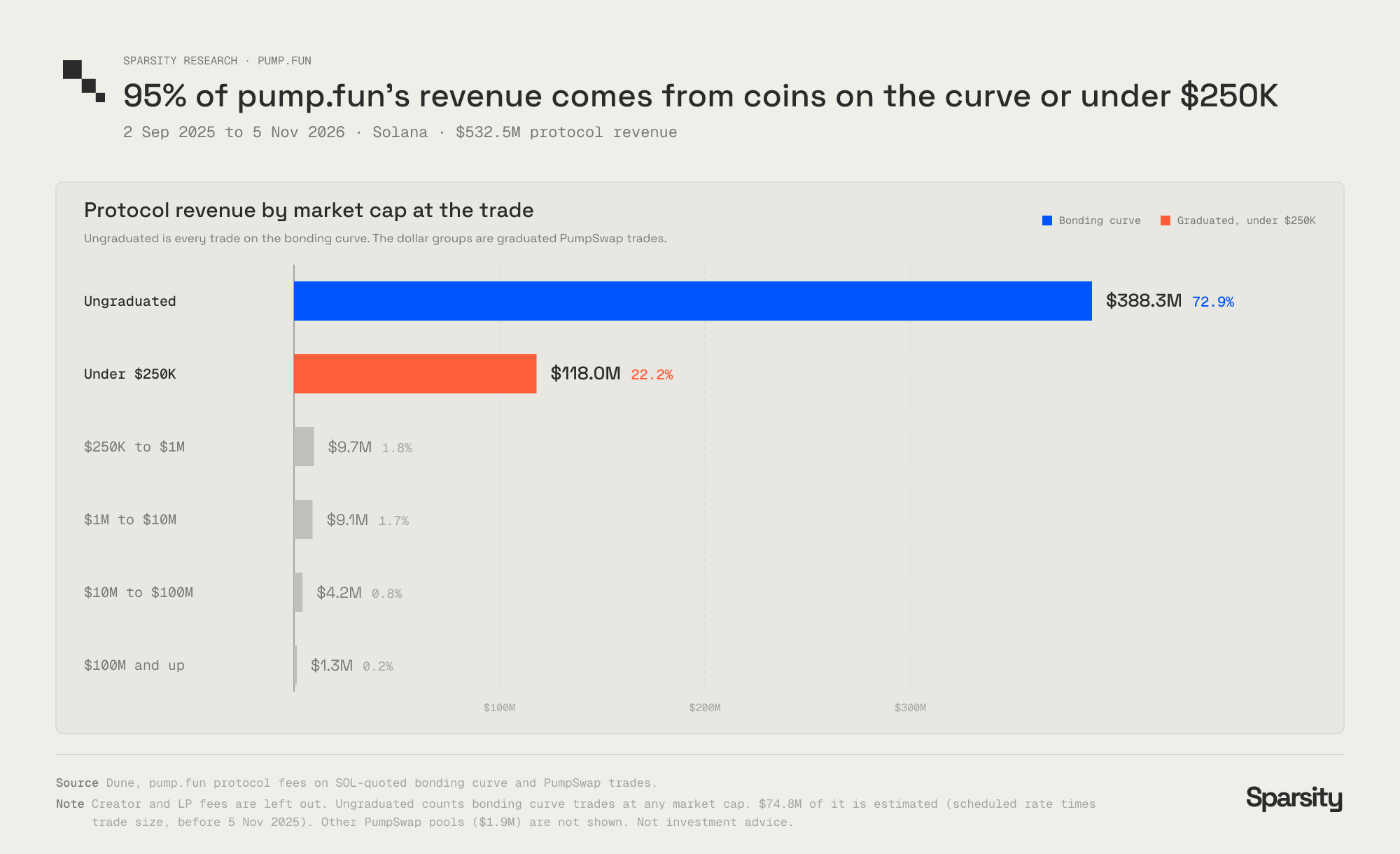
It makes 95% of its protocol revenue from trades while a coin is on the bonding curve or under $250K (in a new tab)2. Every buy and every sell on the curve pays 1.25% (in a new tab)3, 0.95% to pump.fun and 0.30% to the creator (in a new tab)3, so a round trip costs 2.5% before the price moves at all.
Age tells the same story. Three quarters of that revenue (in a new tab)4 comes from coins less than an hour old, and 87% (in a new tab)4 from coins less than a day old.
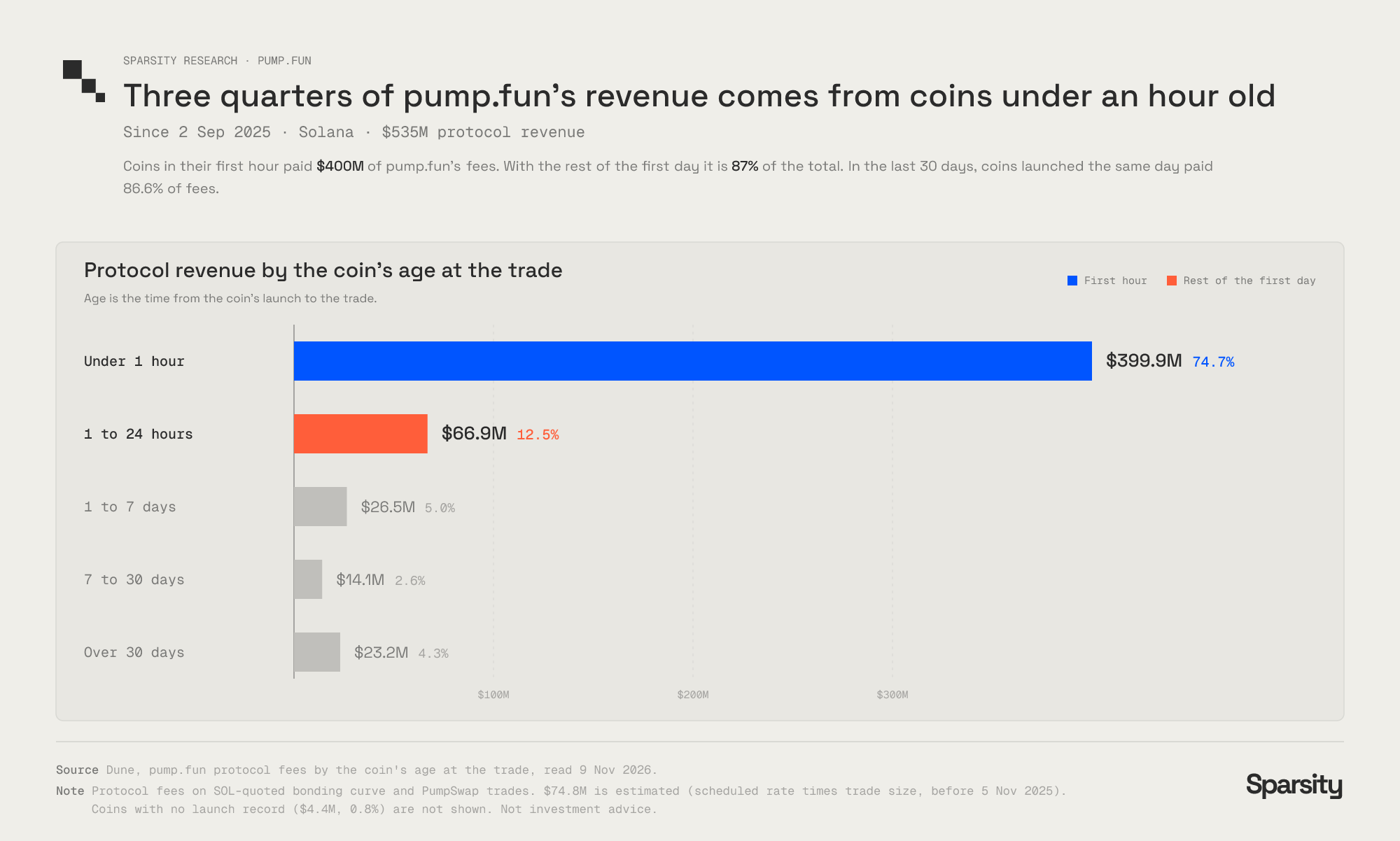
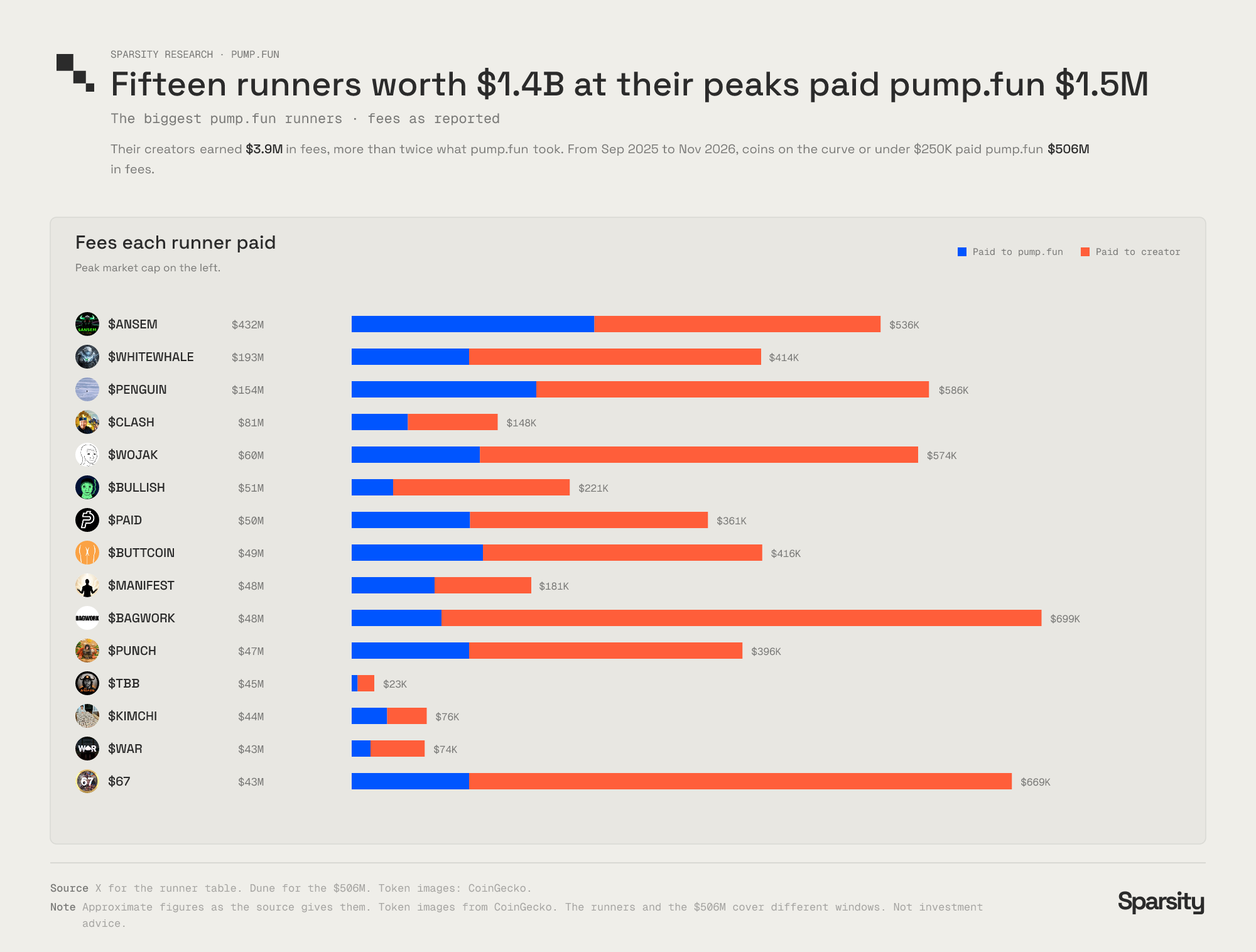
The runners barely register. Fifteen of the biggest, worth $1.4B at their peaks, paid pump.fun about $1.5M between them (in a new tab)5, while coins on the curve or under $250K paid it $506M (in a new tab)2. Put simply, a thousand coins dying at $20K earn it more than one coin running to $100M.
So the product is optimized for more launches. Every incentive on the platform pushes toward quantity, because quantity is what pays.
Four incentives
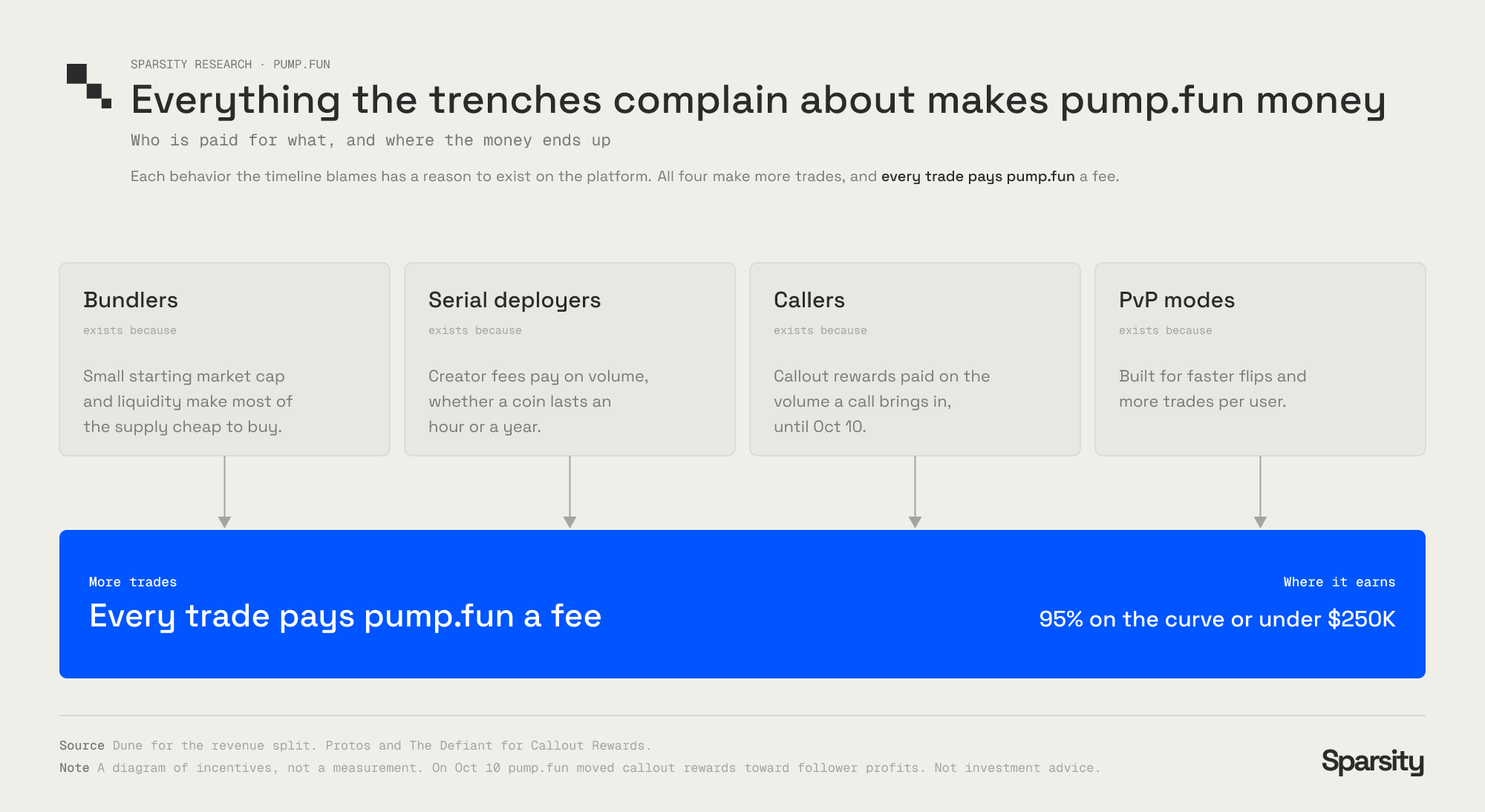
Each behavior the timeline blames has a reason to exist on the platform. All four make more trades, and every trade pays pump.fun a fee.
Bundlers buy the launch block because it's cheap
Bundlers exist because the starting market cap and liquidity are small. A few SOL spread over a few dozen wallets in the launch block buys a big chunk of supply and then the bundle sells on you. The smaller the starting market cap, the cheaper that is, and pump.fun sets them.
Deployers farm launches because creator fees pay on volume
Serial deployers exist because creator fees reward launching over building. A creator earns 0.30% of every trade (in a new tab)3 whether the token lasts an hour or a year, so the best strategy is to launch as many coins as possible, farm the early volume and move on. The top 25 deployers launched 761K coins, fewer than 1 in 100 graduated, and they made $128M (in a new tab)6.
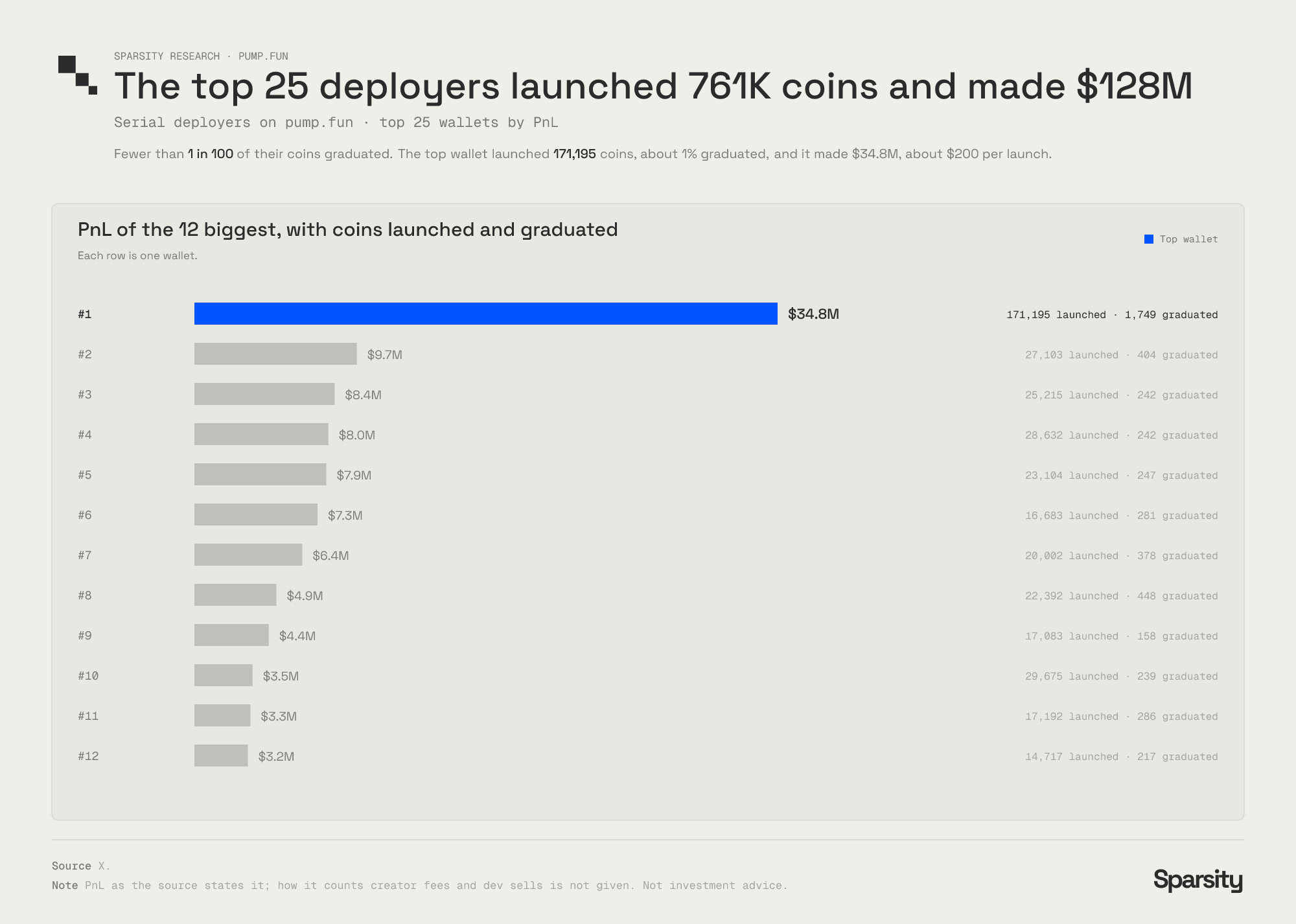
The farms do produce the occasional runner. Two of those wallets' best coins reached $122M and $327M (in a new tab)6. But a runner is a side effect of the volume, and the volume is what gets paid.
Callers push low caps because the rewards pay for volume
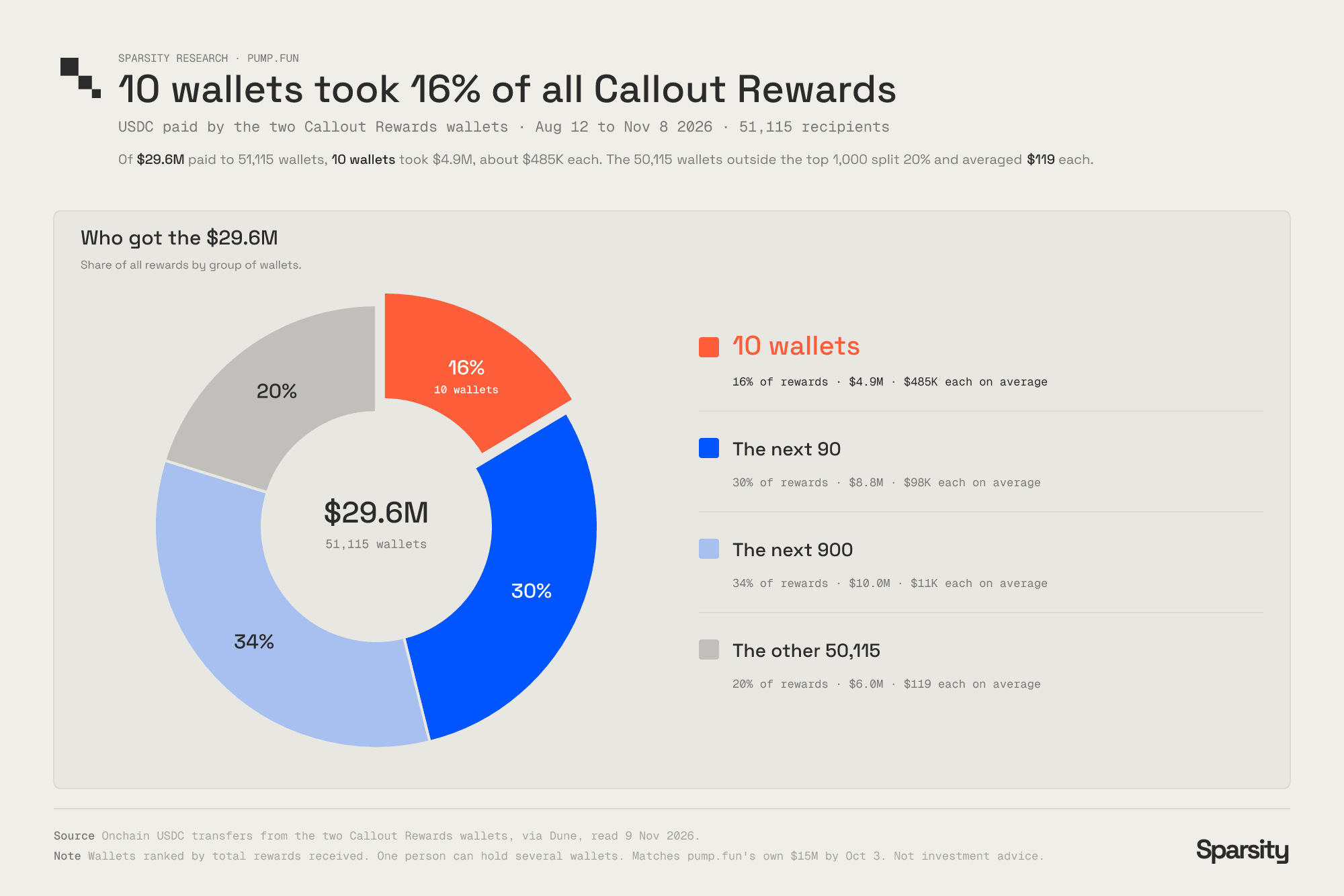
Callout rewards add a new reason to shill. The platform turned shilling into a revenue stream: since August it has paid $29.6M (in a new tab)7 in callout rewards to 51,115 wallets (in a new tab)7, and the money doesn't spread. Ten wallets took 16% (in a new tab)7. The median recipient got $13 (in a new tab)7.
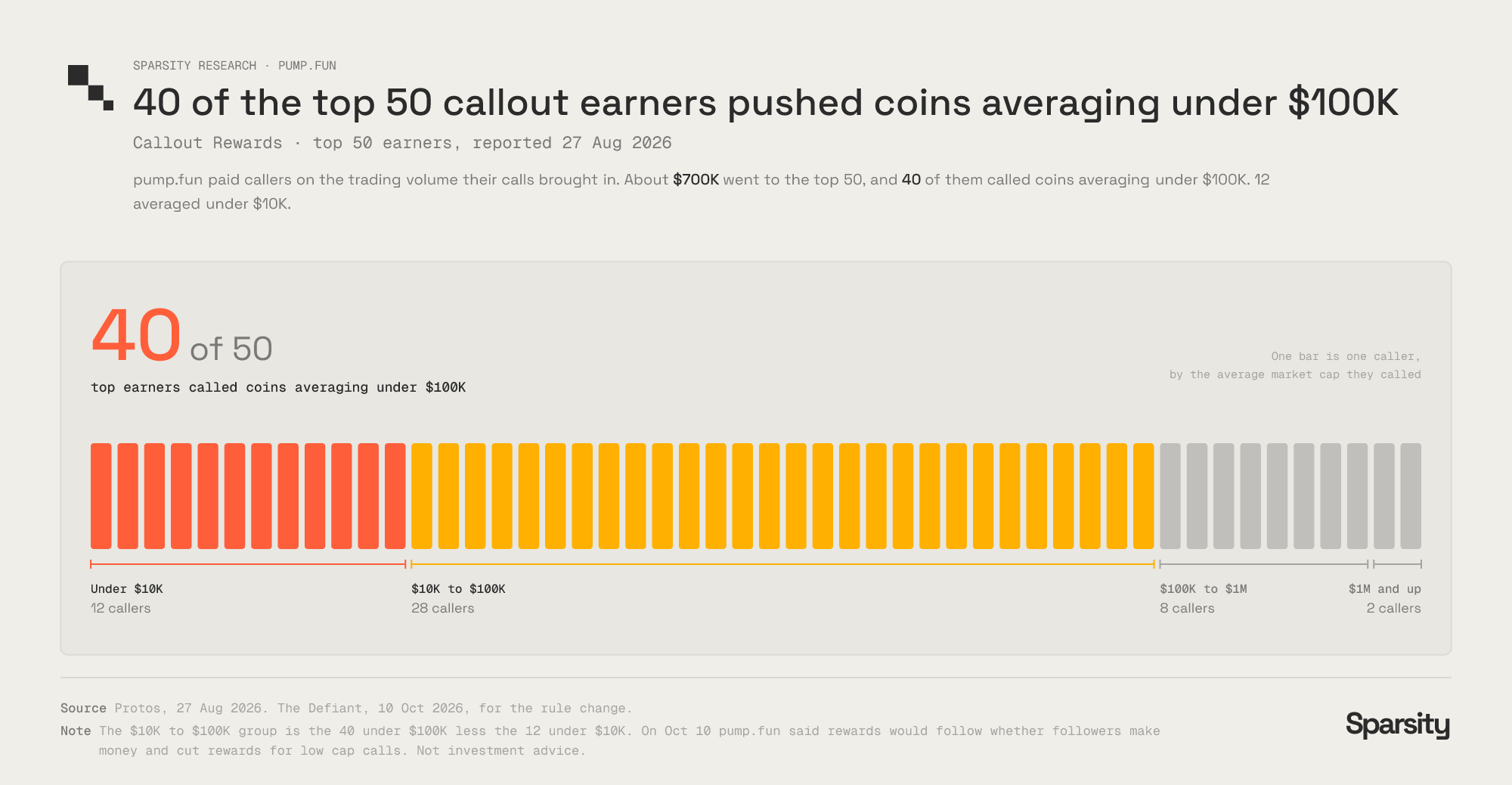
The rewards were paid on the trading volume a call brought in (in a new tab)8, and volume is easiest to move in the smallest coins. In August, 40 of the top 50 earners called coins averaging under $100K (in a new tab)8.
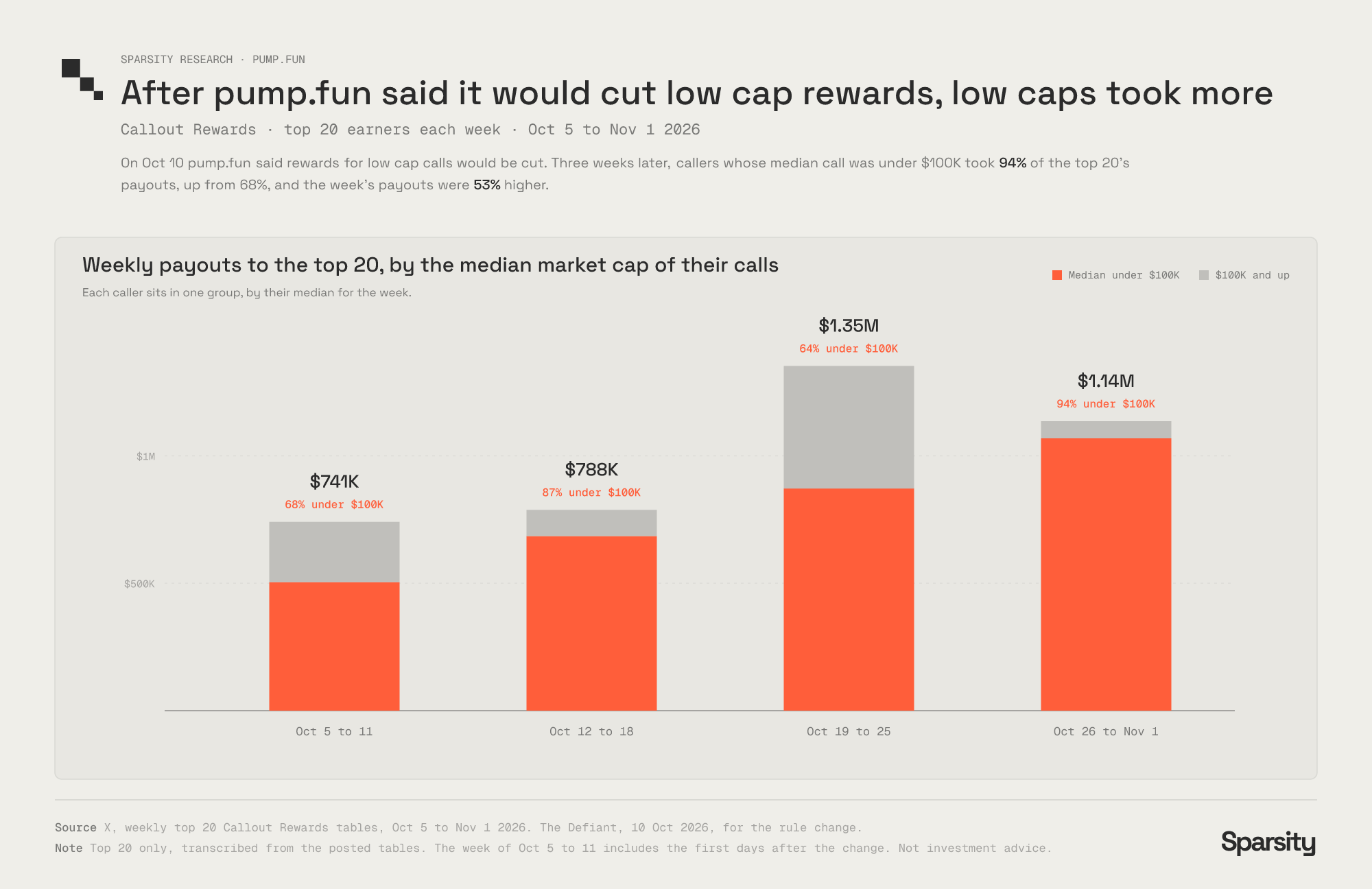
pump.fun has heard this. On October 10 (in a new tab)9 it said rewards would follow whether followers make money and pay less for low cap calls (in a new tab)9. In the three weeks after, the share of the top 20's payouts going to callers whose median call was under $100K went from 68% to 94%, and the weekly payouts rose 53% (in a new tab)10.
The followers carry most of the cost. We tracked fourteen callers. Ten have a median call under $100K (in a new tab)11, and their followers were down $926K (in a new tab)11 a day after the calls. The median called coin is up 6% one minute after the call (in a new tab)12, down 48% after an hour (in a new tab)12 and down 74% after a day (in a new tab)12. The caller gets paid whether the coin goes up or not.
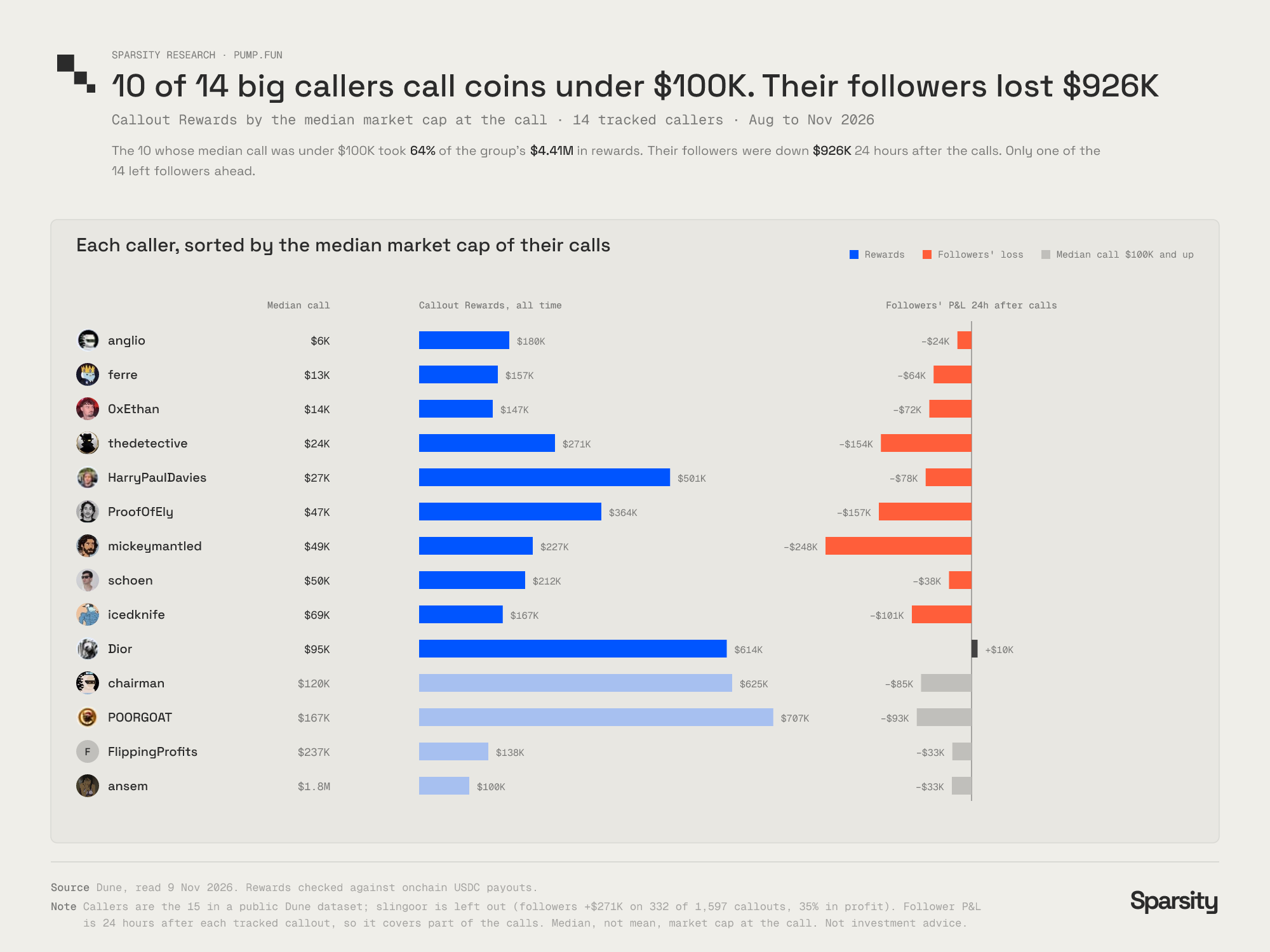
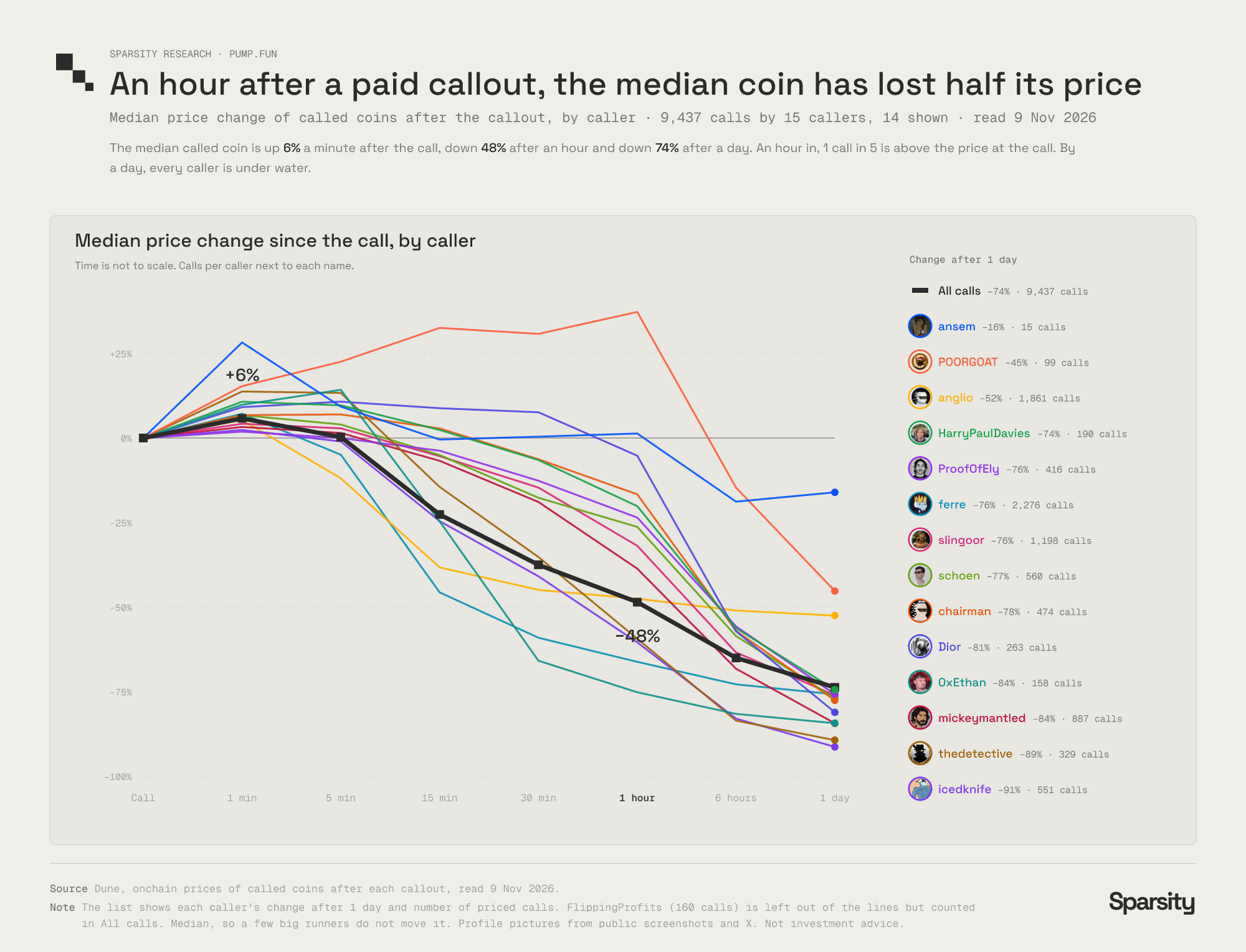
When people ask why KOLs keep pushing coins their followers lose on, this is a big part of the answer. They're paid to.
PvP modes exist for more trades per user
PvP works because there's no new money, so advanced players take from new ones, and the modes are built for exactly that: faster execution, more trades per user, and a fee on each one. pump.fun itself removed one, the Tokenized Agent mode, on June 30 (in a new tab)13, saying that too many ways to launch a token were creating "toxic player-versus-player dynamics" (in a new tab)13.
Infinite supply, disappearing demand
Run these incentives long enough and the market splits in two.
On the demand side, you ape coins, and on average you lose money. Only a tiny share of wallets make anything worth having. On the supply side, you launch coins, and you get paid with almost no risk.
There is no barrier to becoming a supplier. It's one click, and you already know the mechanics: vamp a runner in seconds, fake the volume so it looks alive and buy aged wallets by the hundred. It gets better every month.
So we think more and more of the people who would have been holders become suppliers. Launching pays and holding doesn't, and every new player who figures that out becomes another deployer competing for a thinner pool of buyers. That's what broke holder culture: nobody decided to stop holding, the platform made holding the losing trade.
The result shows up in what the launches produce. pump.fun now launches about as many coins as it did at the height of late 2024. In the last quarter of 2024, 3.16M launches (in a new tab)14 produced 207 coins that reached $10M (in a new tab)15, by our count. In the third quarter of 2026, 3.05M launches (in a new tab)14 produced 24 (in a new tab)15.
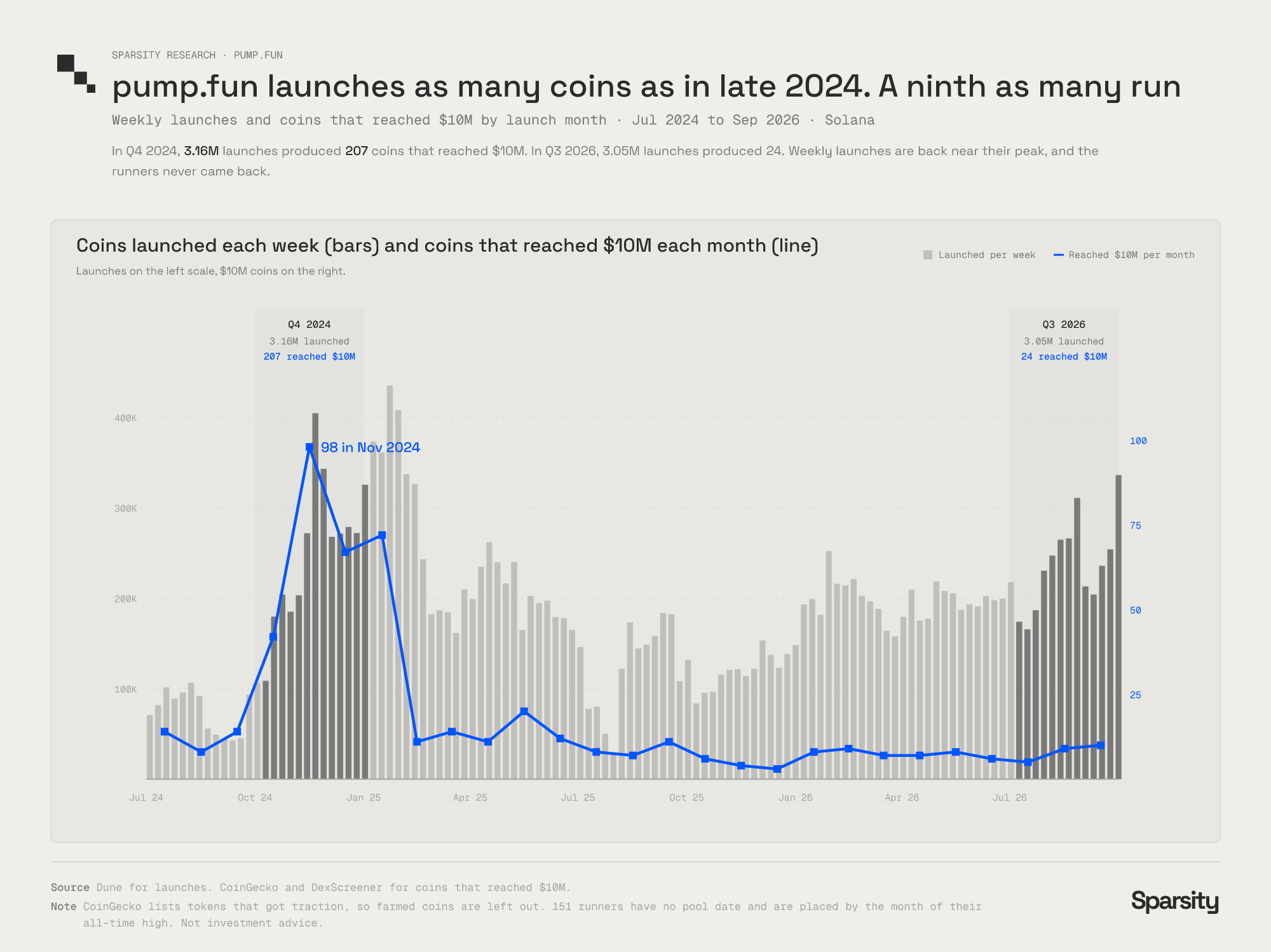
Someone will point out that volume on the bonding curve has been rising since June (in a new tab)16. It has, but curve and PumpSwap volume together fell from about $25B to $30B a month in the first quarter of 2026 to about $13.8B in October (curve (in a new tab)16, PumpSwap (in a new tab)17). And volume is what pump.fun is paid on. Runners are what the people buying are paid on, and those are a ninth of what they were.
Survival tells the same story from the other end. Of pump.fun's 24.4M launches, 312 are above $100K today (in a new tab)18. That's about one coin in 78,000, or 0.0013%.
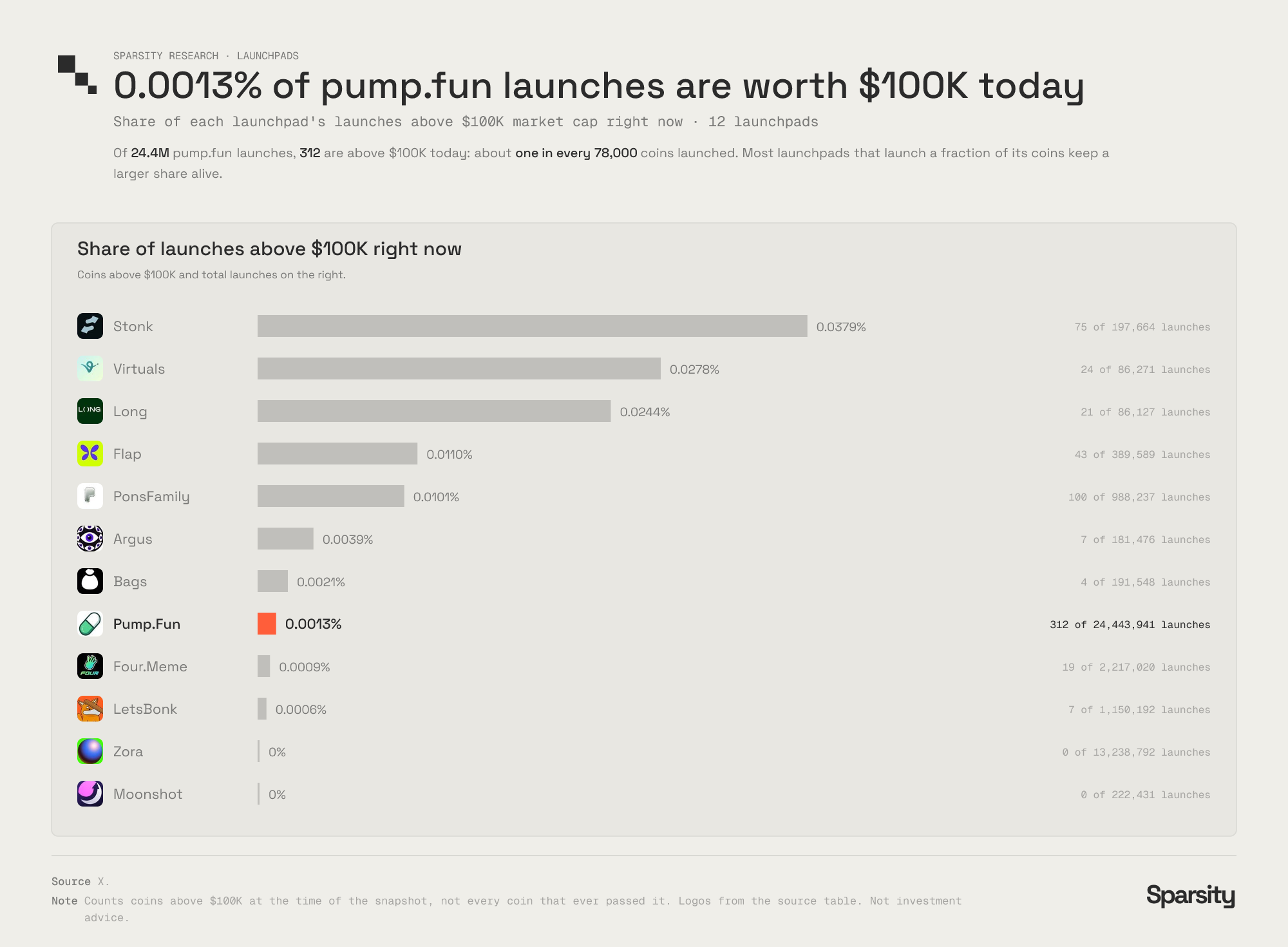
That's the first market we know of with supply rising this fast while demand shrinks, and it would never have reached this scale if the platform didn't pay for it.
It's on us too
pump.fun built the system, but the volume that keeps it running is ours. Every incentive in this piece only pays because someone on the other side takes the trade, and most of the time that someone is us.
We reward the behavior we complain about
We call bundlers the problem and then follow them for the next play. A dev who vamps a runner and walks away with the fees gets a thread about how smart the play was. A caller who posts twenty coins a day gets followed because they're always first, not because their followers make money. Of the fourteen tracked callers above, one left followers ahead (in a new tab)11, and their combined followers were down $926K (in a new tab)11 a day after the calls.
We pay for all of it twice: once with our volume, which is what pump.fun and the creators get paid on, and once with our attention, which is what the next vamp and the next callout are built to capture.
Holding stopped being the strategy
A year ago the play was to find a coin early and hold it through the noise. Now the median called coin is down 74% a day after the call (in a new tab)12, so the people who survive are the ones who sell first. That's rational for each of us, and it's exactly what kills runners for all of us. A coin can't become a $10M coin if nobody holds it past the first hour, and that is where pump.fun earns three quarters of its revenue (in a new tab)4.
What changes if we change
Nobody needs pump.fun's permission for any of this. Hold the coins you believe in instead of flipping every chart. Judge callers by whether their followers made money, not by how often they post. Stop amplifying vamps and bundles as clever plays. And put volume on launchpads that pay for coins that last instead of coins that trade. None of it fixes the incentives on its own, but every trade we don't give to the machine is one it doesn't get paid for.
What would change the incentives
We aren't engineers, so take these as directions, not designs. Each one points the money somewhere other than the first hour of a coin's life.
- A higher starting market cap and deeper initial liquidity, with compounding liquidity so the pool grows with volume.
- Fees shared with holders and LPs, not only creators, and creator fees that vest with how long the token survives.
- Callout rewards that pay for holders, not flippers: callers paid on whether the people who followed the call still hold and are in profit days later, not on the volume the call pulls in.
Something along these lines would keep the trenches alive, and pump.fun can afford to try it. It holds about $2.84B onchain (in a new tab)19 and owns the whole pipeline. A market with runners would make it more over time than one that burns through its buyers. It chooses extraction because extraction pays more today, and that isn't sustainable.
Even that might not be enough. Changes like these make supplying more expensive. They don't change the fact that the supply side has better tools than the demand side will ever have.
What a launch without a curve could look like
Everything above still sits on top of a bonding curve. Going further would mean launching without one.
In this model everyone pays the same price. With no curve, being first in the block buys you nothing, and sniping loses its edge. The creator would set a minimum and a maximum raise. If the minimum isn't hit within a set window, like 24 or 48 hours, the contract would refund everyone automatically, so a failed launch costs buyers nothing. Once the maximum is hit, the contract would create the liquidity pool on its own and burn or lock the LP, so the creator never touches the money raised. Every wallet would have a hard cap on how much it can put in, for example 1% of the raise, so one whale or bot can't take half the supply.
The platform would get paid only when a launch fills. It would earn from launches that succeed, and a thousand launches that never fill would earn it nothing.
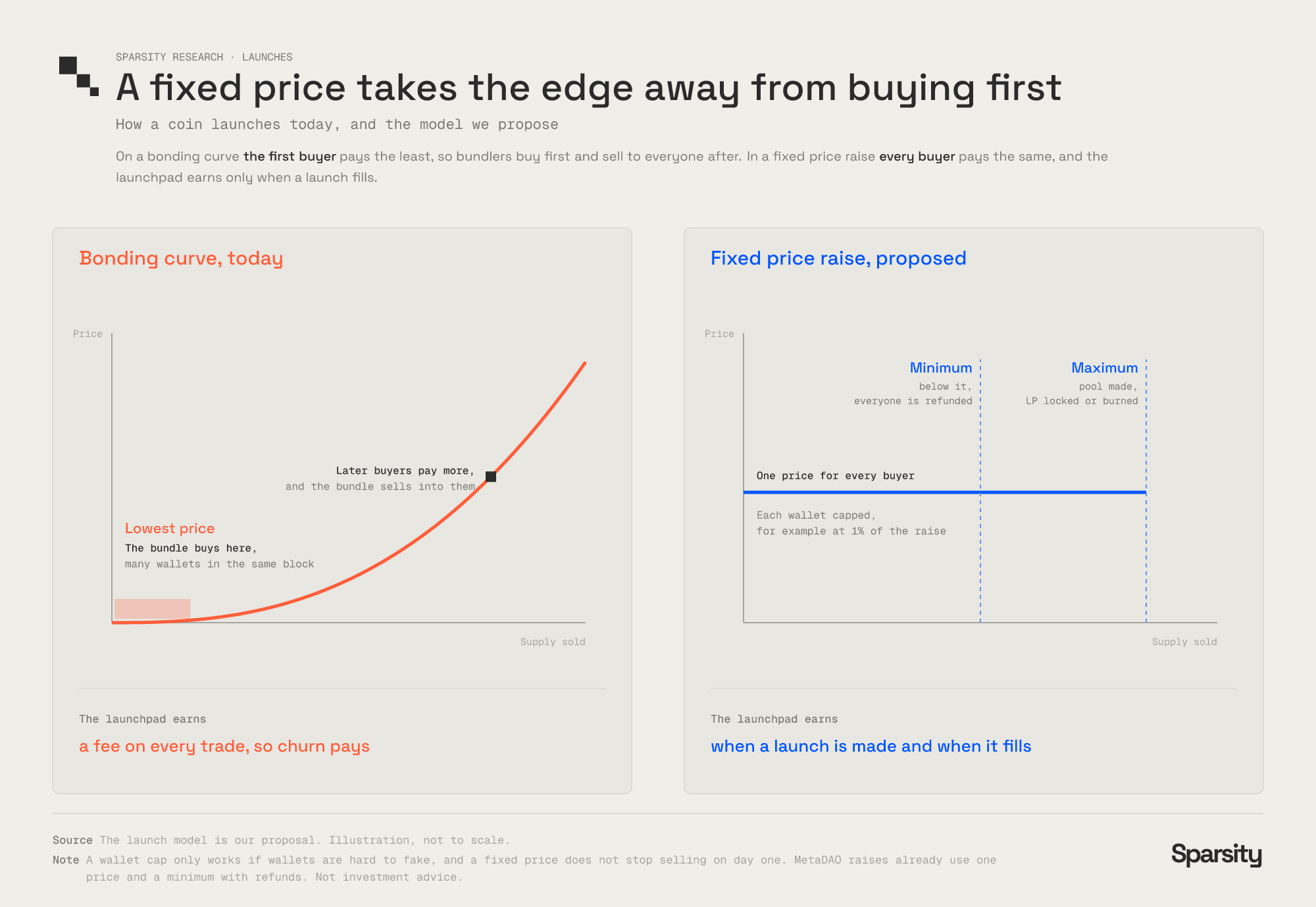
That would remove bundling at the bottom of a curve, sniping, rugs of the raised liquidity, and the reward for launching 50 coins that never fill.
This model has holes, and they're worth naming. Per wallet caps only work if wallets are hard to fake, and aged wallets are cheap right now. Without some kind of sybil resistance, a bundler just splits the buy across 100 wallets. A fixed price also doesn't stop people from selling on day one. It only makes the starting line fair.
What comes next
Memes in their current form are over. We don't think they come back until the launch model itself changes, something like the one above, where the platform earns when coins succeed, not when they trade and die.
As long as one launchpad gets paid for every coin that dies, the trenches stay dead, and holding stays the losing trade. Something new is coming. It just won't be memes, and it won't be soon.
Thanks to launchlytics for the public work behind some of these charts (queries 9084743, 9084680 and 9093218). We used some of it to run our own queries and check the data.
Sources
- launchpad war: memecoin launchpads across every chain (30 days) (in a new tab)tehcscreener, as of Nov 9, 2026 Back
- pump.fun protocol revenue by market cap at the trade (in a new tab)Dune, as of Nov 7, 2026 Back
- Launchpad fees (pump.fun bonding curve: 0.95% protocol, 0.30% creator) (in a new tab)Coinpaprika, citing pump.fun's fee docs, as of Sep 15, 2026 Back
- pump.fun protocol revenue by token age (in a new tab)Dune, as of Nov 9, 2026 Back
- Fees paid by the 15 biggest pump.fun runners (table, verified by Kioto) (in a new tab)X, as of Nov 9, 2026 Back
- Top 25 pump.fun serial deployers by PnL (table, verified by Kioto) (in a new tab)X, as of Nov 9, 2026 Back
- Callout Rewards per recipient (in a new tab)Dune, as of Nov 9, 2026 Back
- Pump Fun paid $700K to callers shilling mostly tiny tokens (in a new tab)Protos, as of Aug 27, 2026 Back
- Pump.fun to Tie Callout Rewards to Followers' Profits (in a new tab)CryptoNews, from The Defiant, as of Oct 10, 2026 Back
- Weekly top 20 Callout Rewards earners, Oct 5 to Nov 1 2026 (verified by Kioto) (in a new tab)X, @dethective, as of Nov 2, 2026 Back
- Callout rewards vs follower P&L, by caller (in a new tab)Dune, as of Nov 9, 2026 Back
- Median price change after a callout, by caller (in a new tab)Dune, as of Nov 9, 2026 Back
- Pump.fun kills Tokenized Agent launch option after community pushback over PVP dynamics (in a new tab)Crypto Briefing, as of Jun 30, 2026 Back
- pump.fun launches by month (in a new tab)Dune, as of Nov 9, 2026 Back
- Pump.fun Ecosystem (in a new tab)CoinGecko, as of Nov 9, 2026 Back
- pump.fun bonding curve volume (in a new tab)DefiLlama, as of Nov 9, 2026 Back
- PumpSwap volume (in a new tab)DefiLlama, as of Nov 9, 2026 Back
- Launchpads: launches and coins above $100K now (table, verified by Kioto) (in a new tab)X, as of Nov 9, 2026 Back
- Pump.fun's $2.8 billion on-chain treasury is mostly its own PUMP token (in a new tab)Crypto Briefing, as of Oct 6, 2026 Back